


By Fr. Michael Nsikak Umoh
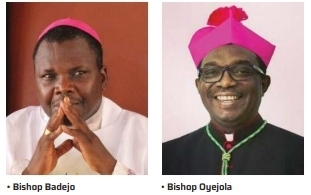
The funeral Mass for the late Bishop Julius Adelakun held on Friday 28 November, 2025, was marked by an inspiring homily delivered by Bishop John Oyejola, who described the departed prelate as a “rare soul” whose leadership was defined by humility, service, and the development of people rather than the accumulation of power or monuments.
While Archbishop Gabriel Leke Abegunrin, the Metropolitan of Ibadan, was the Chief Celebrant at the Mass, Bishop Oyejola gave the sermon. In his sermon, the Bishop of Osogbo diocese reflected on the uniqueness of Bishop Adelakun, noting that “there are people who appear only once in a lifetime, rare souls whose presence leaves an imprint that time cannot erase.” He emphasised that, like such people, Bishop Adelakun’s greatness lay not in charisma or titles but in the quiet strength of who he was, the convictions he stood for, his authenticity, his calm in the face of storms and tribulation, and the way he makes others feel seen, valued, and at peace.
The homilist underscored that Bishop Adelakun’s style of leadership stood in stark contrast to the common tendency in the country where leadership is equated with “power, prestige, and domination.” He stated, “Bishop Adelakun was a man who led not by command, control, or domination. He led with compassion and love. He understood the wisdom of Jesus in the Gospel according to Mark 10:43 ‘Whoever wishes to be great among you must be your servant.’ He was a servant leader.”
Bishop Oyejola recounted personal experiences that illustrated Bishop Adelakun’s humility and commitment to transparency: “I remember when he was working for the creation of a new diocese from the old Oyo diocese, he kept everyone informed, not because he had to, but because he believed that trust grows in the light.” He added that Adelakun often reminded his collaborators that “if you don’t communicate clearly, you help the spread of rumour,” framing communication as “an act of justice; an act of charity, and an act of respect for human dignity.”
The bishop further highlighted Baba Adelakun’s legacy of forming leaders rather than mere followers: “Baba’s greatest legacy is not the projects he completed, but the people he formed. He built leaders, not followers. He saw potential in people and drew it out with patience, mentorship, and care.” Oyejola noted how Adelakun’s mentorship produced “5 Bishops and numerous men and women for service and leadership,” emphasizing that these outcomes were “a consequence of his dedication and commitment to human development.”
Quoting the late bishop’s episcopal motto, “Faith and Culture”, Bishop Oyejola explained that Bishop Adelakun “dedicated his life to building the faith of others and celebrating the richness of our culture. For him, faith gave life meaning, and culture gave faith expression.” He added that this motto served as “a call to all of us to live with depth, purpose, and authenticity.”
Additionally, on Adelakun’s humility, the preacher recalled the simplicity of the bishop’s home and his willingness to sacrifice comfort for the growth of others: “He gave up comfort so others could grow. He lived not for applause, but for service.” He linked this humility to the Gospel of Matthew 23:12, noting that “those who humble themselves will be exalted,” and affirmed that Bishop Adelakun’s true greatness stemmed “not because of his title but because of his heart and person.”
In concluding his homily, Bishop Oyejola reminded the congregation of the Christian hope that underpinned the funeral: “Our faith assures us that death is not the end, but a passage into eternal communion with God.” He invoked the words of Jesus in Matthew 25:21, “Well done, good and faithful servant… enter into the joy of your Lord,” expressing confidence that these words would be spoken to Bishop Adelakun “today and forever.”
Present at the funeral Mass were the Archbishops of Ibadan and Lagos Archdioceses, the Bishops of the dioceses of Ekiti, Ilorin, Wukari, Kastina, Ijebu Ode, Abeokuta, Ondo, and Osogbo,. The Bishops Emeriti of Ondo Diocese, and Ibadan Archdiocese. There were priests, religious and the lay faithful in their numbers. There were also dignitaries of other faith communions, state and traditional rulers.
The funeral rites had started the previous evening with the vigil Mass celebrated by the chief mourner, Bishop of Oyo diocese, Most Rev. Emmanuel Badejo. While Bishop Jude Arogundade received the body at the entrance of the Cathedral, Bishop Francis Adesina preached the homily. In his homily, he described Bishop Adelakun as a pioneer and one of the first-generation indigenous bishops of Yorubaland, whose simplicity, pastoral zeal, and dedication to the service of God and humanity are striking. He further remarked that Bishop Adelakun embodied the humility of a true shepherd: “He knew when to diminish so that God may increase.”