


Book Review: “Enhancing Communication in the Parish Community”
Author: Fr. Michael Nsikak Umoh
Reviewer: Very Rev. Fr. Melvis Mayaki


Introduction
It is a great honour to be invited to this book launch as the reviewer. The author, Very Rev Fr. Michael Nsikak Umoh, the National Director of Social Communications at the Catholic Secretariat of Nigeria (CSN), is an outstanding priest, eloquent preacher, seasoned administrator, and a consummate communicator.
The title of the book is: Enhancing Communication in the Parish Community
The Publication
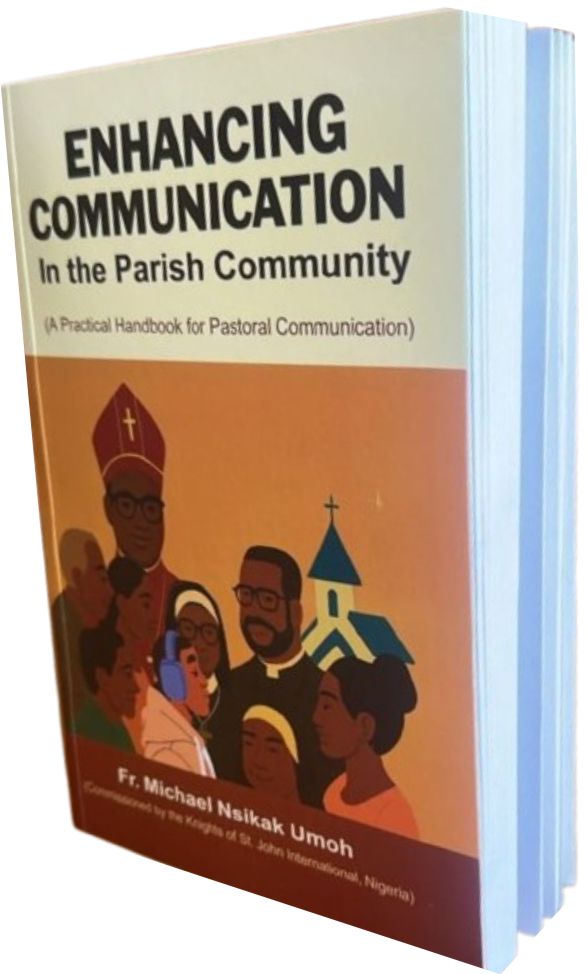
The book front cover is of esthetically beautiful graphics with images depicting the different people in the church, and the book title boldly written in chocolate colour background. There is also a subtitle, “A Practical handbook for Pastoral Communication” written in cap and low directly below the title. The back cover is intentionally of solid chocolate colour with the blurbs reversed in deep yellow. The book is rendered in A5 size, well bounded and neat. There are 272 pages in all, with the frontispiece composed of a gift address page, inner title page, the imprimatur, dedication, foreword and preface pages. At the back of the book are the reference and index pages
Endorsements
To show how well ecclesiastically endorsed this book is, the imprimatur is given by our own dear Archbishop Alfred Adewale Martins, the Archbishop of Lagos. An imprimatur is an official approval by a Bishop for printing a book related to the faith. The Nihil Obstat, given by Bishop Gerald Musa, guarantees that this book is not only free from error, but edifying for the body of Christ. It is worthy of note that Bishop Gerald Musa is a professor of communication studies, and the immediate past Head of Department of the prestigious Center for Study of African Culture and Communication (CESACC) in Port Harcourt.
The author, Fr. Michael Umoh, must have earned enormous trust and respect from his overall boss at the Catholic Secretariat of Nigeria, Most Rev. Lucius Iwejuru Ugorji, the Archbishop of Owerri Archdiocese, who is currently the President of the Catholic Bishops’ Conference of Nigeria (CBCN). Archbishop Ugorji is not sparing in his high approval and recommendation of the book. He said:
“Rev. Fr. Michael Nsikak Umoh, our National Director of Social Communications, has rendered the Church a profound service through this brilliant work.”
By this, Archbishop Ugorji underscores the book’s ecclesial importance, noting that “without effective communication, the parish risks becoming a mere administrative unit rather than a living community of faith.” This sets the tone for the book’s scholarly depth, reminding readers that communication is integral to ecclesiology. He therefore goes on to say:
“I wholeheartedly endorse this handbook to strengthen parish life and deepen communion … Let it be in the hands of every priest, religious, catechist, lay leader, liturgical minister and pastoral agent … Let it be studied in all our seminaries and novitiates; referenced in pastoral councils, and implemented in parish offices.”
It did not stop there, Cardinal John Onaiyekan, in the epilogue, highlights the theological grounding of the work. He affirms the book’s relevance for the Church’s mission today, stating that “Fr. Umoh has offered us not just a manual of communication, but a vision of how the parish can become a true family of God through dialogue, listening, and mutual respect.”
Furthermore, Bishop Emmanuel Badejo, known for his expertise in communications, in the blurb praises the book as “a practical and spiritual guide for ministers who wish to make their parishes vibrant centers of communion and evangelization.” His endorsement situates the book within the broader pastoral communication tradition.
I guess my work would have been done at this point since as Catholics we are formed to trust and follow our shepherds. Concerning this book, our shepherds have spoken, and spoken clearly. Nevertheless, it is still important to briefly explore the content of the book, in order to savour its richness and beauty.
Inside the Pages
The realities of the sentiments expressed by the Bishops about this book are indeed contained in the 23 chapters of the book where communication is approached not as a technical skill alone but as a theological and pastoral imperative. Since communication is the lifeblood of every form of community, our seasoned pastoral communicator situates the parish within the broader mission of the Church, emphasising that effective communication is inseparable from evangelisation, catechesis, and pastoral care. He makes it clear that communication in the parish is not merely about transmitting information but about fostering communion, building trust, and nurturing faith.
Thus some of the very practical relatable issues treated in the book include: the nature and mission of the Church; the primary role of the parish priest (all priests) as leader and builder of the parish community; the ecclesiology of the laity; signages; the need for parish phone line and parish data; how to approach the often neglected sound system; place of Images & Icons in the Church; how to make the best of the parish bulletin and publications; training parish office workers in relational skills; how all liturgical ministers are necessarily communicating elements of the parish….from the usher, to the choir and even the altar servers; the need to embrace the opportunities provided by the digital media and modern media technologies like the projector, for liturgy and evangelisation. Furthermore, the book touches on how cleanliness and timeliness communicate sacredness and respect; the role of a parish announcer and the need/how to establish a Parish Communication Committee in all parishes.
Writing Style
All these thoughts and much more have been rendered in simple, easy to understand English language, devoid of high grammar. In order to also enhance the interest in reading, the fonts are in Constantia and 11 points for eligibility and reading delight. The provision of subheadings for almost all the chapters further makes for easy reading.
The images introduced at the beginning of each chapter are quite apt, fulfilling their purpose of ‘one good picture being equal to a thousand words.’ One can say that the general presentation of the book is itself a model of its core message…that communication must be skillfully package in order to be effective. According to Marshal McLuhan, ‘the medium is the message’.
One must not fail to note that beyond its scholarly rigor, the book is deeply motivational. Fr. Umoh writes with pastoral warmth, urging ministers to see communication as a vocation within their vocation. He challenges priests and pastoral agents to move beyond announcements and bulletins, toward genuine dialogue and relational ministry. He offers strategies for preaching, parish meetings, digital evangelization, and interpersonal communication—all framed within a spiritual ethos. He invites his audience to embrace communication as a ministry of presence, empathy, and listening. As Cardinal Onaiyekan notes, “the parish that communicates well is the parish that loves well.”
Timely & Apt Response
Fr. Michael Nsikak Umoh’s Enhancing Communication in the Parish Community is a timely and profound contribution to pastoral theology and practice. With endorsements from eminent Church leaders, the book stands as both a scholarly church resource and a motivational guide for priests, seminarians, ministers, and pastoral agents. It is a vade mecum for communication in the Catholic church, especially in Nigeria.
For the priests this book provides tools to strengthen ministry, homilies, building communion, publication, and parish leadership. For the seminarians, it serves as a formation manual, preparing them for ministry in a communication-driven world. For ministers and pastoral agents, it equips them to foster collaboration, resolve conflicts, and build inclusive communities. For the church at large, it offers a template for, and vision of, parishes as dynamic centres of communion, evangelization, and social transformation.
Conclusion and Call for Action
From the foregoing, it is safe to say that Enhancing Communication in the Parish Community is more than a book; it is a pastoral roadmap, and as noted by Lady Ivy Onua in her blurb, “it is a movement”. With the wisdom of Archbishop Ugorji, Cardinal Onaiyekan, and Bishops Badejo and Musa framing its message, Fr. Umoh’s work emerges as a beacon for the Church. It is scholarly in its depth, motivational in its tone, and practical in its guidance.
Fr. Umoh’s book is a prophetic voice to challenging us to build a Church that listens and communicates effectively, ministers who embody the Gospel in word and deed, and parish communities that are vibrant, inclusive, and mission-driven. It is a profound and inspiring masterpiece that every priest, seminarian, minister, and pastoral agent should own. It is a spiritual compass, a pastoral toolkit, and a theological gem rolled into one. It is the response to the much-desired direction in the area of communication which we all have often craved for in one way or the other. We now have it. We must respond positively and decisively.
I call on all of us here to generously support this movement, so that this message will get to all institutions and persons to bring about the desired change.
On behalf of all of us, I say a very big congratulation to Very Rev. Fr. Michael Nsikak Umoh for this masterpiece.
Thank you all for your kind attention.