


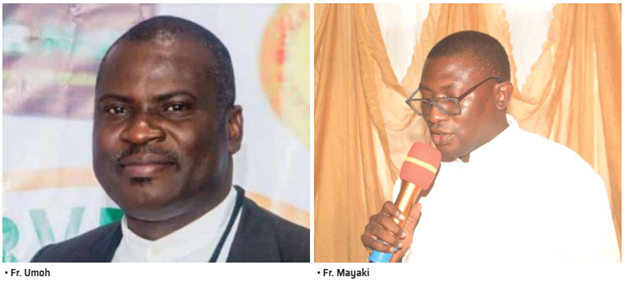
Wednesday, December 3, 2025, was a day of ecclesial and intellectual firepower as Very Rev. Fr. Melvis Mayaki, Dean of Festac Deanery, Archdiocese of Lagos, presented an incisive review of Enhancing Communication in the Parish Community, the latest pastoral masterwork by Very Rev. Fr. Michael Nsikak Umoh, National Director of Social Communications, Catholic Secretariat of Nigeria (CSN). The book—already drawing resounding endorsements from top-ranking Church leaders, was unveiled at St. Agnes Catholic Church, Maryland, Lagos, with Fr. Mayaki describing it as “a pastoral roadmap, a theological gem, and a movement.”
In his review, Fr. Mayaki introduced Fr. Umoh as “an outstanding priest, eloquent preacher, seasoned administrator, and consummate communicator.” The 272-page handbook, rendered in a clean A5 format with striking graphics, was lauded as a model of what it teaches: communication executed with clarity, creativity, and purpose. With its subtitle, A Practical Handbook for Pastoral Communication, the book is designed as both a training tool and an everyday companion for priests, religious, seminarians, catechists, parish workers, and pastoral agents. The book did not merely come recommended; it arrived stamped with some of the strongest hierarchical approvals in recent memory.
Archbishop Alfred Adewale Martins, Archbishop of Lagos, granted the Imprimatur, formally approving the text for Catholic teaching, just as Bishop Gerald Musa, professor of communication studies and former Director, Centre for Studies on African Culture and Communication (CESACC), issued the Nihil Obstat, vouching for its doctrinal purity and pastoral value. And the endorsements kept coming. In a profound tribute, Most Rev. Lucius Iwejuru Ugorji, Archbishop of Owerri and President of the Catholic Bishops’ Conference of Nigeria (CBCN), declared, “Fr. Umoh has rendered the Church a profound service through this brilliant work… I wholeheartedly endorse this handbook to strengthen parish life and deepen communion.”
He urged that the book be placed “in the hands of every priest, religious, catechist, lay leader, liturgical minister, and pastoral agent,” and incorporated into seminary and novitiate formation. John Cardinal Onaiyekan, Archbishop Emeritus of the Archdiocese of Abuja, in the epilogue, lauded the book as a theological beacon for the modern Church. He said, “Fr. Umoh has offered not just a manual of communication, but a vision of the parish as a true family of God through dialogue, listening, and mutual respect.”
Most Rev. Emmanuel Badejo, Bishop of Oyo Diocese and a member of the Vatican Dicastery for Communication, added his voice, calling it “a practical and spiritual guide for ministers who wish to make their parishes vibrant centres of communion and evangelisation.” For Lady Ivy Onua, the book rises above scholarship: “It is not just a book; it is a movement.” Fr. Mayaki walked the audience through the book’s 23 chapters, describing the work as a blend of theology, pastoral practicality, and communication science. It tackles the parish as a living organism whose unity hinges on intentional communication.
Among its standout themes are:
• The parish as a spiritual home
• The priest as chief communicator and culture shaper
• The ecclesial mission of the laity
• The tragedy of the “Catholic microphone”
• The power of signage, sound systems, and sacred spaces
• Parish data management and dedicated parish phone lines
• Liturgical ministers as communicators—from ushers to choirs to altar servers • Digital evangelisation
• The pastoral value of cleanliness, punctuality, empathy, and listening
The book also insists on training parish staff in “pastoral sensitivity, parish operations, and phone etiquette,” a point Fr. Mayaki underlined as long overdue. The Dean applauded the book’s layout, simple language, readability, and creative chapter visuals, noting: “The presentation is itself a model of its core message… the medium is the message.” The reviewer praised Fr. Umoh’s pastoral tone, noting that he writes not as a technician but as a shepherd urging priests and lay ministers toward relational ministry, deeper communion, and authentic engagement. Describing the book as “timely and prophetic,” Fr. Mayaki said it responds directly to the Church’s contemporary communication challenges—from chaotic parish announcements to poorly managed sound systems, from communication gaps between clergy and laity to the need for digital readiness.
He emphasised that the book serves:
• Priests as a ministry enhancer
• Seminarians as a formation manual • Pastoral agents as a practical toolkit
• Parishes as a blueprint for mission-driven community life
In his insightful conclusion, Fr. Mayaki urged widespread adoption of the book, declaring: “We now have the guide we have long desired. We must respond positively and decisively.” He called on institutions, parishes, and individuals to support the dissemination of what he described as “a masterpiece, a spiritual compass, and a pastoral toolkit rolled into one.”
Some of the book’s most striking lines include:
• “The parish is the sacred meeting place where the People of God are formed into one body.”
• “Relying on personal mobiles for parish communication jeopardises clergy well-being.”
• “Punctuality embodies reverence for God and respect for the community.”
• “Cleanliness becomes a visible expression of the parish’s commitment to holiness.”
• “When parishioners experience a community that listens as much as it speaks, trust deepens.”
• “Technology is not a substitute for personal interaction.”
As the event closed, it was clear that Fr. Michael Umoh’s book is set to become a defining reference for parish life in Nigeria and beyond. Fr. Mayaki led the audience in congratulating the author, declaring the work a “beacon for the Church” and “a movement whose time has come.”