


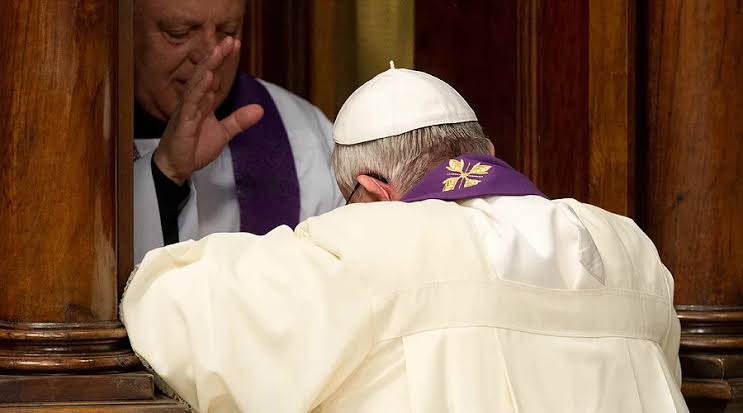
WHY CONFESS YOUR SINS TO A PRIEST?
By Very Rev. Fr. Dr. Michael Nsikak Umoh
A. NAME
CONFESSION, PENANCE or best known as the sacrament of RECONCILIATION.
- BASIC OUTLINE of this work
- INTRODUCTION
- PROTESTANTS POSITION
- STATING THE PROBLEM
- RESPONSE
- FACTS ON CHURCH
TEACHINGS
B. INTRODUCTION
- A contentious issue of faith for ages
- Even within the Church. Issue of how to celebrate the sacrament. From outside the Church, there has been age long protest from the Protestants.
- So, not a new matter
- As far back as the time of Jesus. Therefore, as a foundation to this whole discourse, let us critically assess the Healing of the Paralytic in the Bible:
- Matthew 9:1-8; or Mark 2:1-12; or Luke 5:17-26.
- Matthew 9:1-8English Standard Version (ESV) (Jesus Heals a Paralytic)
- And getting into a boat he crossed over and came to his own city. 2 And behold, some people brought to him a paralytic, lying on a bed. And when Jesus saw their faith, he said to the paralytic, “Take heart, my son; your sins are forgiven.” 3 And behold, some of the scribes said to themselves, “This man is blaspheming.” 4 But Jesus, knowing[a] their thoughts, said, “Why do you think evil in your hearts? 5 For which is easier, to say, ‘Your sins are forgiven,’ or to say, ‘Rise and walk’? 6 But that you may know that the Son of Man has authority on earth to forgive sins”—he then said to the paralytic—“Rise, pick up your bed and go home.” 7 And he rose and went home. 8 When the crowds saw it, they were afraid, and they glorified God, who had given such authority to men.
- For saying “… your sins are forgiven.” Jesus received very strong condemnation because indeed, “Only God can forgive sins!”
- Therefore, if Jesus, who is God, was condemned for forgiving sins because he became man, one can understand the difficulties even sincere minded Protestants have in contending how God can allow mere human beings to be an instrument of this great divine function.
- But the truth is that there are more devious and opportunist Protestants today than sincere ones who act only out of ignorance.
C. PROTESTANTS POSITION
- (Copied from an argument by a protestant)
- No man can forgive sins but God alone, therefore every sinner must approach him individually.
- The New Testament does not teach that there are to be priests in the New Covenant. First Peter 2: 5-9 describes believers as a “holy priesthood” and a “royal priesthood.” Revelation 1:6 and 5:10 both describe believers as “a kingdom of priests.” In the Old Covenant, the faithful had to approach God through the priests, but not in the New Covenant.
- The priest as mediator between the people and God is no longer necessary because, we can now approach God’s throne with boldness (Hebrews 4:16) since
- Jesus Christ is our great High Priest (Hebrews 4:14-15; 10:21) and the only mediator between us and God (1 Timothy 2:5).
- On confession of sin, believers are told in 1 John 1:9 to confess their sins to God.
- 1 John 1:9 New International Version (NIV) says: “If we confess our sins, he is faithful and just and will forgive us our sins and purify us from all unrighteousness.”
- James 5:16 speaks of confessing our trespasses “to one another,” but this is not the same as confessing sins to a priest.
E. STATING THE PROBLEM
- What can we make of all these positions? What are Protestants really up against here? Is it that sins should not be confessed to human beings at all? Or that it should not be confessed to human beings who are priest? Or is the problem that human beings, the priest in this case, cannot forgive sins? Or is it that there is no more sins that need to be forgiven, therefore no need for anyone to confess or to forgive sins? What is the REAL ISSUE?
F. RESPONSE TO OBJECTIONS
- The Catholic teaching is that no man can forgive sins but God. The Catholic Church never taught otherwise at any time. The teaching of the Church is unequivocal that it is God alone who forgives sins, while the priest at the confessional only acts in the person of Christ as his face of mercy, like a doctor, reconciling people back to God. Catechism of the Catholic Church (CCC). 1441 Only God forgives sins.
- Doctors do say: “We cure, God heals.” That is exactly the case. The priest treats the soul through prayers and guidance, but God forgives the sin.
- The words of ABSOLUTION AT THE CONFESSION is very clear that it is not the Priest who forgives sins but acts in the person of Christ. He says: “…..I forgive you in the name of the Father and of the Son and of the Holy Spirit.” It is in the name of God. He never says, go I forgive you; but …in the name of ……
- That is the same trinitarian formula we use at baptism: I baptize you in the name of the Father, and of the Son, and of the Holy Spirit.”
- If we can baptize this way and there is no objection, why the objection when it comes to Confession.
- By the way Christians generally agree and believe that baptism cleanses us of original sin.
- If the action by a man can bring about such spiritual effect at baptism, why not the action of the priest at the confessional?
- PROOFS FROM THE CATHOLIC HYMN BOOK THAT WE BELIEVE IT IS JESUS WHO FORGIVES AND NOT THE PRIEST. (Use the old CHB, not the 40th anniversary edition)
- CHB 13. vs 1 & 4 “…humbly confess we, who have sinned against thee, all our misdoings, hidden now no longer.” “May thy redeeming, mercy find us pardon”
- CHB 24 cf. vs 2 & 3. “…but pardon first the blindness, of all our sinful ways”.
- CHB 90 vs 1 Who I’m I my Jesus, that thou comest to me. I have sinned against thee, often grievously, I am very sorry. I have caused thee pain, I will never, never, wound that heart again”.
- CHB 94. vs 2. “It is he who forgives all our guilt, who heals every one of your ills, who redeemed your life from the grave, who crowns you with love and compassion…”
- CHB 194 “God of mercy and compassion, look with pity upon me, Father let me call thee Father, Tis thy child returns to thee”.
- CHB 196 “Jesus my Lord, behold at length the day. When I resolve from sin to turn away. O pardon me Jesus, thy mercy I implore. I will never more offend thee, No, never more”.
- One thing we have sufficiently demonstrated from the above is that even when we go to the Priest for confession, it is not as if it is the priest who has been offended nor do we expect that it is the priest who forgives us our sin sins. Our sins are against God and it is the mercy of God that we seek. There is no song in the Catholic Hymn Book which in any way suggests that sins are committed against priests or that it is the priest who forgives sins. Note Galatians 6:1 Restore your brother caught in sin
- The question now is: So why confess sins through the Priest? Why not go directly to God. Can we not go directly?
- Catholic Church is grossly misrepresented, at times very intentionally for devious and sinister reasons.
- We believe that we can approach God directly to seek forgiveness for our sins.
- In the Catholic Church, we have different ways of seeking God’s forgiveness for sins because we are also aware that there are different categories of sins: Mortal and Venial sins.
- 1 John 5:16 says “If any man sees his brother sinning a sin not unto death, he shall ask, and God will give him life for them that sin not unto death. There is a sin unto death: not concerning this do I say that he should make request.
- All the hymns we shared earlier are means of seeking God’s forgiveness directly. For instance, we sing (pray) “God of mercy and compassion, look with pity upon me”.
- At the beginning of Holy Mass, we say “I confess to Almighty God, and to you my brothers and sisters, that I have sinned”. This is surely confession of sins directly to God and to one another.
- It follows that in the Catholic Church, we confess our sins directly to God, to one another and through the priest
- More often to one another and directly than the sacramental confession.
- This is because, the Church also teaches that the main way mortal sins can be forgiven after the sacrament of baptism is through the sacrament of penance/reconciliation.
- Another point raised by protestants is that we do not need priests or intercessors. That we do not need priests or intercessor in the New Covenant is not true.
- The Catholic Church teaches common priesthood and the ministerial priesthood. We need the ministerial priesthood because of the new covenant sacrifice instituted at the last supper. Matthew 26:17-30; Luke 22:7-23.
- The hymn: Priestly people, Kingly people, Holy People, God’s chosen people, sing praise to the Lord. This refers to the entire Christ’s faithful gathered to worship God.
- Protestants position of no priesthood follows from the distorted interpretation of John Chapter 6; on the institution of the Eucharist. Cf. King Henry VIII …desacralize the Church to suit his desire.
- As long as John 6 means the true body and blood of Christ, it means it is a sacrifice. If it is a sacrifice, it means you need the priest because of the 3 important elements of sacrifice are: THE ALTAR, THE PRIEST and THE VICTIM.
- This also explains why the ALTAR is the center of the Catholic Church building, whereas the Stage is the center of a Pentecostal AUDITORIUM, therefore the pastor can vacate it for comedians or the Choir to entertain the “audience”.
- The Catholic Church as the custodian of the Bible are in better position to interpret all parts of the bible, certainly not all the new churchpreneurs multiplied and scattered everywhere.
- We all know this simple truth how much matters of faith have been so bastardised by people who have no business with God and have no concern for salvation. It is all around us in this age more than ever;
- But most of the arguments today are those of derailed groups, who are mostly not fit in any way to be called a community of Gods children, not fit to be called a church, but who often seek excuses to justify their fall.
- They are machinations by so many false pastors and prophets whose only concern and motive is MONEY.
- Jesus said: “This is my blood of the new covenant, it will be shed for you and all men, for the forgiveness of sins. Do this in memory of me.”
- Curiously while Protestants condemn the need for the priesthood, what do we see today? Holy Communion service multiplied, some now dressing like priests and performing things they do not understand. What for? It is a whole protestant confusion!
- On mediator-ship,
- The Catholic Church never denied the eternal mediating role of Jesus.
- At the Holy Mass, it is Jesus who offers himself as the Priest and the victim to the Father through the Holy Spirit. Therefore …. the priest after the whole consecration process ends by saying: “Through him, and with Him and in Him (referring to Jesus), in the unity of the Holy Spirit, all glory and honor belongs to you Almighty father, forever and ever.”
- Jesus is the full face, full revelation of the Father. (cf. Heb. 1:1ff) He who is with the Father from all time, it is he who comes from the Father and knows the Father. True!
- Notwithstanding, even experience shows that Christians continue to need mediators. That is why Jesus chose to share his power with men on earth.
- Please note James 5:14 as it says:
- “Is anyone among you sick? Let him call the elders of the church, and let them pray over him, anointing him with oil in the name of the Lord. And the prayer of faith will save the sick, and the Lord will raise him up. And if he has committed sins, he will be forgiven.”
- What more do we need to say in order to understand? Elders of the Church, not just any elders, are to be called to pray and anoint, the prayer will bring about healing and FORGIVENESS OF SINS. The ‘elders’ are the presbyters … the priests.
- Is this not intercession? This is one passage we need to study very closely as there are more points of relevance to our present discourse.
- The passage highlights the intercessory role of priests, Jesus transferred powers to the Church to be used for the well-being of the community.
- Meaning of SACRAMENT, a sign. …when certain actions are performed, some words said and some objects used as prescribed and directed by Jesus, all these external signs (outward signs) can cause some spiritual benefits (inward graces) in the life of the recipient. That is what James 5:14 described; a biblical basis for the sacrament of anointing in the Church.
- No controversy here, if we are sincere
- Back to Matthew 9:1-8, we need to understand some hard messages contained therein and why Jesus was very emphatic.
- When the people accuse Jesus of blasphemy, he challenged them in strong terms: “Why do you think evil in your heart” because anything that will hold humanity to ransom of sin is evil.
- He then goes on to say, “That you may know that the son of Man has power on earth to forgive sins. (He did not just say “…son of Man has power.” But “power on earth”. NOT JUST IN HEAVEN, BUT ALSO ON EARTH.
- Incarnation is God’s mercy applied to human misery. It would make no meaning if the grace is not made available to men.
- “When the multitude saw it, they marveled and glorified God, WHO HAD GIVEN SUCH POWERS TO MEN. (The same people who had accused Jesus of blasphemy now turn around to marvel. They marveled because what they witnessed with their eyes was not normal, it is a strange experience but true. God shared that great power with men. He established different means for men to receive forgiveness for sins and be reconciled to God. That is the heart of the incarnation…RECONCILIATION. If there was no sin, there will be no need for God to send His Son to become one like us.
- Thus, JESUS TRANSFERS POWER UNTO HIS DISCIPLES. It was after his death and Resurrection, in his glorified body, that he speaks of Sending the disciples out and breathing on them. This is very instructive.
- “As the Father has sent me, so I am sending you….” John 20:19-31
- HE BREATHED ON THEM. “Receive the Holy Spirit…..
- Luke 24: 47-49
- “Repentance and forgiveness of sins will be preached in his name to all nations, beginning from Jerusalem, You are witnesses of these things. I am going to send you what my Father has promised; but stay in the city until you have been clothed with power from on high.”
- Note that the passage commands the apostles to stay action UNTI THEY HAVE RECEIVED POWER FROM ABOVE.
- Acts 1:8 goes further to say: “But you will receive power when the Holy Spirit comes on you; and you will be my witnesses in Jerusalem, and in all Judea and Samaria, and to the ends of the earth”
- The disciples must receive power in order to accomplish Christ mission. They must wait for the power. It is the power that established the Church. Denying the power is denying the Church.
- Not surprising, most of these bodies are business organisations and not Church, and can never be the Church.
- IF YOU FORGIVE, THEY ARE FORGIVEN… John 20: 23 and Matthew 16:19… giving of the keys of the kingdom and Matthew 18:18-20
- If the apostles are to forgive or not forgive (in the name of Christ’s) they must first hear what the sins are, before you can know whether to forgive or not. Priests are judges at the confessional, acting with mercy in the name of Christ.
- (John 14:12) says He that believes in me, the works that I do shall he do, even greater works than these shall he do, because I go unto my Father.”
- Read the whole of John 14. Reveals what happens after him. It is about transfer of power. John14: 10-14…I will do whatever you ask in my name, so that the Father may be glorified in the Son. You may ask me for anything in my name, and I will do it.
- Matthew 9: 13. I desire mercy and not sacrifice. For I did not come to call the righteous, but sinners, to repentance.
- It is strange ….. some pastors deceive their followers and deny the sacrament of Reconciliation on the grounds that we do not need any mediator since Jesus is the only mediator.
- But have you wondered about what exactly they do when they gather people for revivals and special prayer sessions and when they cajole the people to sow seeds.
- If we do not need intercessors, then we do not even need any Church or pastors. Everyone should be encouraged, may be through phone or TV to pray directly to God.
- Why pray for someone since he needs no intercessor?
- Many pastors make a whole lot of money today praying for, fasting on behalf of, and anointing the people…whether with sincerity or by deception
- On the idea of confessing sin to one another which they prefer:
- We can deduce that, at least they believe that sins can be confessed to another human being.
- How that actually happens still beats my imagination.
- Whatever the modality, the fact that they agree that we can confess our sins to one another reveals the illogicality of the resentment against confessing to a priest.
- If by the way you agree that people can confess their sins to one another, then, why not to the priest?
- What is the essence of confessing to one another, if no forgiveness is received?
- Which is better, to confess to just anybody and everybody, those who lack the power and the training in spiritual matters, or to confess to one who is dedicated to serving God and have been trained in spirituality and the art of counseling and is well versed with the scriptures and things that pertain to God?
- The Catholic Church approach is definitely more sensible and effective for holiness of life and for building a healthy Christian community and a sane society. We know the beauty and power of the sacrament, except those who have not applied themselves to it.
- The truth as we all know today is that Protestants are not sincere on this point because while they condemn the Catholic practice, they all are engaged in all manners of counseling sessions which involves person-to-person encounter, except that, unlike the Catholic Church, they use the opportunity often to enrich themselves by charging the people money for consultation, use information gathered during such sessions to hold the people to ransom, and end up more often leaving the people worse. We know this practice to be true!
- The next point has to do with our understanding of the Nature/Sense of sin which is highly distorted among Protestants. The truth be told, the sense of sins has been serious corroded among protestants and in this age.
- Matthew 8:1-4. Healing of a leper. And Luke 17. 1-14.
- Leprosy in the bible symbolizes devastating nature of sin in human life and community. That is generally accepted by almost all Christians. In both healings (of lepers) Jesus always referred those healed to go show themselves to the priest.
- He could have told them to go home or go away, and that will be sufficient. But he always insisted that lepers who are healed go show themselves to the priest and offer prescribed sacrifice.
- Shows that Jesus definitely desired to involve men in the process of forgiveness, reconciliation and the mission of salvation.
- Note that the need to go show self to the priest was only applied to the healing of lepers, not other healings. E.g when he healed the man with the withered right hand, Jesus did not ask him to go show himself to the priest. (Matthew 12:9-14)
- The need to go show self to the Priests underscores the nature of sin.
- The Church teaches that there are 3 dimensions of sin. Akin to the disease of Leprosy, every sin offends God, the community and the individual.
- 1440 Sin is before all else an offense against God, a rupture of communion with him. At the same time it damages communion with the Church.
- Romans 14:7 says: None of us lives for himself only, and none of us dies for himself only. If we live , it is for the Lord. If we die, it is for the Lord.
- True Reconciliation therefore entails being at peace with all.
- If leprosy is to the body what sin is to the soul, one cannot be a doctor treating his sickness nor can one be a judge in his case. This trivializes the seriousness of sin. Imagine that someone steals seriously wrecking a whole ministry or establishment thereby jeopardising the lives of so many people and their many more dependents, then goes home to lock his door and prays for forgiveness. Of what use if he goes on to enjoy his loot. It is a foolery!
- “For if the sick person is too ashamed to show his wound to the doctor, the medicine cannot heal what it does not know.”
- Experience and common sense shows the relief we find when we make a good confession and hear the soothing words of God through the counsel of a priest.
SOME FACTS ON THE TEACHINGS OF THE CHURCH (1)
- Names
- Called the Sacrament of Penance, Reconciliation, Confession and Peace
- Meaning
- One of the seven sacraments of the Catholic Church in which the faithful obtain absolution for the sins committed against God and neighbour and are reconciled with the community of the Church. By this sacrament Christians are freed from sins committed after Baptism. The normal way to be absolved from mortal sin, by which one would otherwise condemn oneself to Hell.
- TYPES OF SINS
- 2 types of sin. (CCC. 1854) (1 John 5:17) Mortal sins are a “grave violation of God’s law” and Venial sins, the kind that “does not set us in direct opposition to the will and friendship of God”,
- BRIEF HISTORY
There are three major periods in the historical development of the sacrament:
- Early Christian penance — from the Apostolic times till the 6th-7th century
- Tariff penance — from the 7th century till the 12th-13th century
- Individual confessions — from the 12th century onwards.
- From the Canon Law
- Canon 983#1 “A priest alone is the minister of the sacrament of penance.”
- In order to be able to be absolved validly from sin, the priest (sacerdos) must have the faculty to do so granted to him either by canon law or by the competent Church authority.
- The role of the priest is as a minister of Christ’s mercy. He acts in persona Christi.
On Frequency of reception
- Canon 989 of the 1983 Code of Canon Law states: “After having reached the age of discretion, each member of the faithful is obliged to confess faithfully his or her grave sins at least once a year.” And as often as the opportunity avails as soon as we are in mortal sin.
- Sacramental seal
- The priest is bound under the severest penalties to maintain the “seal of confession“, absolute secrecy about any sins revealed to him in confession. Confessional seal to be protected even at the risk of the priest’s life. A priest who breaks that confidentiality incurs latae sententiae (automatic) excommunication reserved to the Holy See.
Important Aspects of the Sacrament
- Contrition (Sincere sorrow for sin and a resolve not to go back to it) Most important step.
- Accusing the self before a priest.
- Satisfaction: Penance and restitution
- Absolution
Of the two conversions in the Church, “there are water and tears: the water of Baptism and the tears of repentance. (St. Ambrose_
When last did you go for CONFESSION? DO NOT BE AFRAID, GO, THE LORD IS WAITING TO RECEIVE YOU AND FORGIVE YOU. GO FOR TRUE HEALING.
May God bless you. Amen
(Very Rev. Fr. Dr. Michael Nsikak Umoh is a priest of Lagos Archdiocese, currently on a national assignment as the National Director of Social Communications at the Catholic Secretariat of Nigeria, Abuja. By acknowledging the author, this material can be used in magazines. Anyone who may want to produce it in form of a simple pamphlet for distribution, will need express permission and collaboration with the author. Contact: 08023062860).
Click to view on Microsoft Word