

…says Tinubu leaves impression of disdain, insensitivity to pain of Nigerians
…accuse rulling class of enriching themselves with palliatives
Following the recent ruling by the Presidential Election Petition Court (PEPC), the Catholic Bishops’ Conference of Nigeria (CBCN), has warned that continuous disregard for the will of the people who for once trooped out to vote for their desired candidate, was a threat to the nation’s democracy which was currently in a dangerous position.
This was as the Bishops maintained that political leaders who were incapable of fostering the welfare of their citizens or who worked against their people’s interest and well-being have no moral justification to continue in power whether they were elected or not.
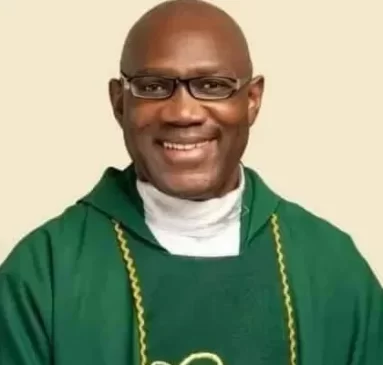
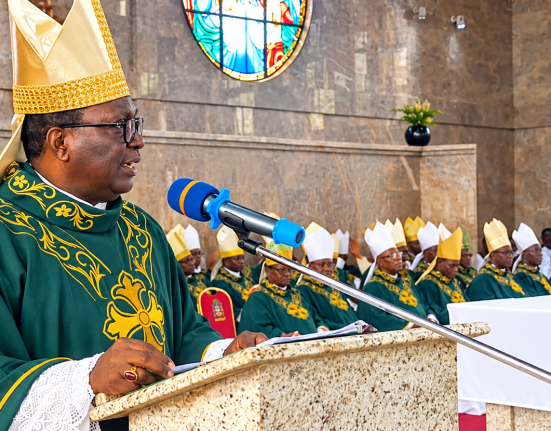
President of the CBCN and Archbishop of Owerri, Lucius Iwejuru Ugorji who spoke at the opening ceremony of the 2023 Second Plenary Assembly of the CBCN on Sunday in Abuja, noted that the many pitfalls and irregularities evident before, during and after the elections destroyed the confidence of Nigerians in the nation’s electoral process which was “flawed by threats, intimidation, violence, the spilling of blood, poor logistics arrangement, inducement, impunity as well as the lack of transparency, manipulation of results, abuse of the power of incumbency, alleged “glitches” and outright rigging.”
Ugorji who further noted that the 2023 elections fell short of the people’s legitimate expectations as well as moral and legal standards despite reassurances by the INEC to deliver credible general elections, prayed for a day when all election results reflecting the will of the people would be decided at the polling units and not at the Court.
He said: “Nigerians were disappointed that INEC failed to upload the presidential results in real-time as promised. By the time the Chairman of INEC, Prof. Mahmood Yakubu, declared the presidential results, the results from thousands of polling units had not been uploaded on the IReV and a high percentage of the uploaded results, required for the verification and authentication of the manual results, were defaced or blurred.
“In some instances, irrelevant objects were uploaded on the IReV. Contestants in the presidential election, who protested against the electoral process and the results hurriedly declared by the INEC Chairman, were advised to go to court, and they did.
“After hearing their petitions, the Presidential Election Petition Court (PEPC) delivered its ruling in a marathon judgement on 6 September 2023. The five Justices of the Election Petition Court unanimously dismissed the petitions. According to them, they lacked merit.
“Despite the billions of Naira of tax-payers money appropriated for the provision of the BIVAS technology as a game-changer in our general elections, the Judges in their ruling tried, among other things, to suggest that it was wrong to expect INEC to keep its promise or obey the electoral regulation of transmitting election results electronically in real-time from the polling units. While respecting the views of the Judges, two of the petitioners rejected their verdict as lacking in justice and so have decided to head to the Supreme Court to seek justice.
“As this case moves to the next level, the fate of the country continues to hang in the balance and the future of democracy in our land stands on the edge of a precipice. We pray and hope that the Supreme Court Judges will neither bend the law nor seek to satisfy the whims and caprices of any party. We also pray and hope for a day in our nation when all election results will be finally decided at the polling units and not at the Court.”
The Cleric said President Ahmed Bola Tinubu leaves an impression of a leader who was “disdainful and insensitive to the economic pain of the masses,” by having the largest Federal Executive Council since the inception of the Fourth Republic in 1999, accused the ruling class of further enriching themselves through the palliatives they promised would help make life better for the common Nigerians suffering from the “hasty and ill-planned” removal of fuel subsidy which has thrown millions of Nigerians into abject poverty and unsure where their next meal would come from.
“People have continued to live in a state of tension and uncertainty in our communities as they are subjected to a life of deepening poverty, chronic hunger, untold hardship and wanton suffering. This situation has been worsened by the hasty and ill-planned removal of fuel subsidy, the floating of the Naira and the galloping inflation, which have affected the cost of food items, transportation and other essential goods.
‘The efforts of the government to provide succour to cushion the harsh effects of the withdrawal of subsidies have not had any significant impact on the lives of millions of Nigerians groaning under the excruciating economic hardship unleashed on them by the ruling class. On the contrary, the distribution of palliatives has largely turned out to be an attempt by the leadership to further enrich themselves at the expense of the suffering masses.
“How else can one see the whopping sum of money allocated in the name of “palliatives” to 306 newly elected members of the National Assembly (NASS) and the National Judicial Council (NJC) headed by the Chief Justice of the Federation respectively at a time when the Judiciary is handling election petitions. What an outrage!
“It is no less outrageous that at a time when millions of Nigerians are not sure of their next meal, N40 billion was allocated to the members of the NASS for luxury cars, including bullet-proof vehicles for the leadership of the NASS, and a further N70 billion for furniture and repairs of the lawmaker’s office.”
The Bishops also appealed to the federal government to secure and protect the lives and property of Nigerians, urgently check the proliferation of small arms and light weapons which was fueling insecurity, drastically cut down the high cost of running its affairs, address the ever-deepening poverty and growing youth unemployment.
Furthermore, the Bishops appealed to the leadership of the Economic Community of West African States (ECOWAS) and the African Union (AU) “to resist the temptation of military intervention as a solution to the leadership crisis in some African countries that have recently experienced military coups. Rather they should continue to explore the more peaceful option of diplomatic negotiations.
“While we denounce coups, we must, however, state loud and clear that political leadership exists to promote the common good.”