
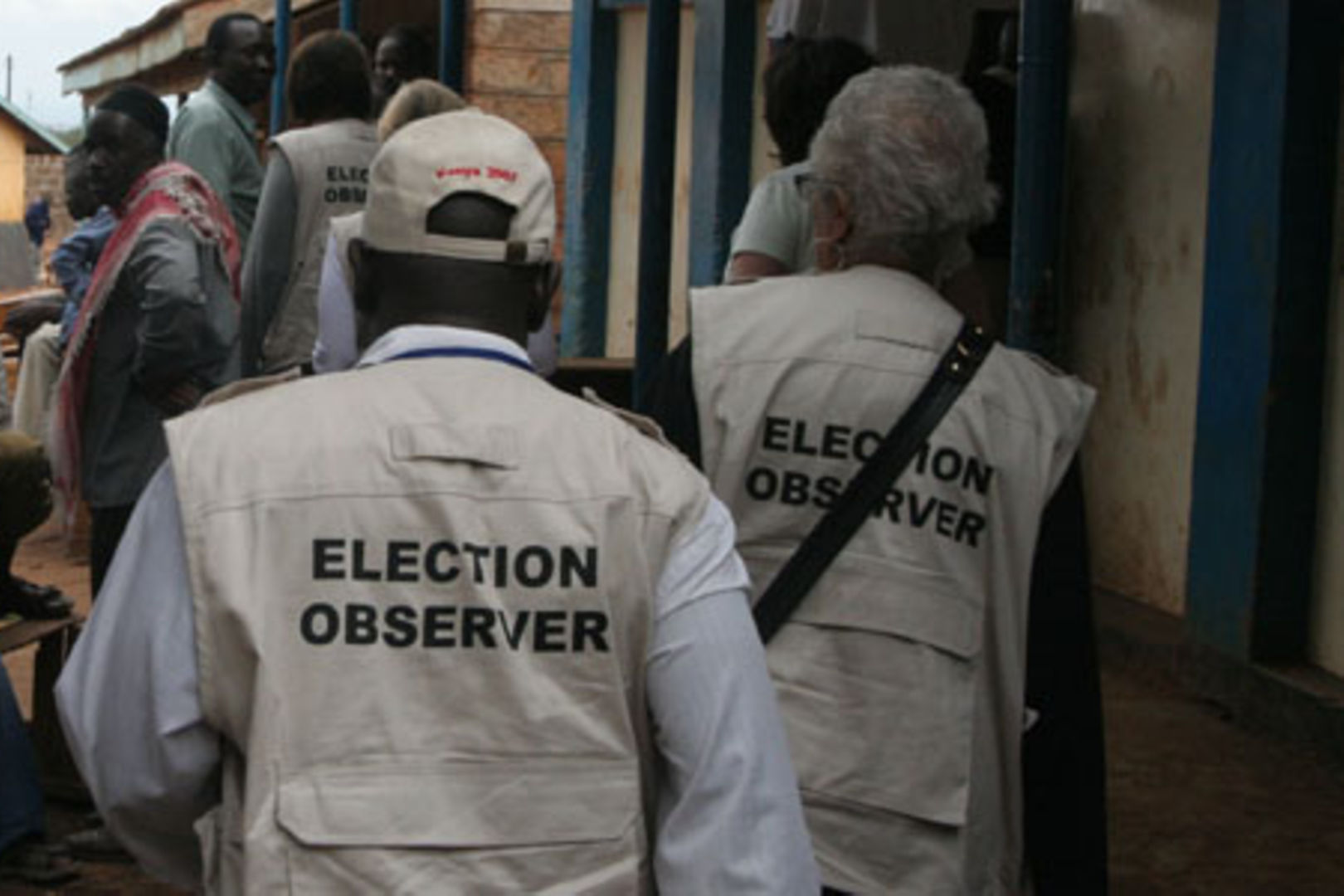
GENERAL OVERVIEW OF ELECTION OBSERVATION/CONTENT
- What is Election Observation?
- Why Observe Election?
- Who is an Observer?
- How Many Types of Observers are they?
- What are the Differences between Election Observation & Monitoring/Supervision?
- What to Observe.
- What are the Criteria for Accreditation?
- What is the Code of Conduct for Observers?
- What are the Responsibilities of Observers
- What are the Responsibilities of INEC
- What are the contents of Observers’ Checklist
- What is the Structure of Observers’ Reports and Recommendations
- Extracts from the 2022 Electoral Law
- WHAT IS ELECTION OBSERVATION?
Election observation is the process whereby elections in a particular country or locality are observed against set standards by an independent and impartial body of Observers with the aim of identifying whether the elections conform to accepted parameters of democratic governance, and making recommendations on how the process can be improved upon in the future.
In simplified terms, election observation entails four main activities:
- Observe the processes and activities before the polling day/s.
- Observe election day activities;
- Observe post-election activities
- Interpret the facts gathered against the laws governing elections as well as basic democratic standards, in order to see whether or not the elections meet the threshold of credibility as defined by the local and international statutes; and
- Outline the findings so collated and the interpretation based on them in a document or report.
An election is a process and not an event. To that extent, election observation should cover all the activities undertaken in connection with an election. A credible election is not just premised on events of Election Day. It is also based on the legal framework, prevailing political environment, respect for individual rights and internal party structures, and collaboration among all the actors in the electoral process. Several election-related activities typically precede and follow voting.
Activities that precede voting include:
- constituency delineation,
- party primary and candidates’ selection processes,
- registration of voters,
- campaigning,
- distribution of voting materials and management of distribution logistics,
- training and accreditation of election workers, including party agents, etc.
- Legal frameworks guiding elections
All these impact the outcome of an election and are as important as the election proper. After voting, there is usually counting and tallying of votes, collation, and declaration of results.
If these activities are conducted diligently with fairness, independence, and even-
handedness by the electoral umpire, the parties, candidates, and observers are likely to regard the elections as credible, genuine, free, and fair; and the likelihood of legal challenges is severely minimized, if not eliminated entirely. Most times, elections are won and lost before Election Day. Many electoral malpractices capable of determining the results of elections are also mostly committed before or after Election Day.
Therefore, election observation should ideally focus on the whole electoral process. However, such an approach has immense cost implications and most Observer Groups focus on Election Day since it is the culmination of the entire process and, it largely mirrors the aspects of the process. To that extent, it represents a reasonable point of engagement and this guideline focuses mainly on observing the voting and result collation, and result declaration processes. However, Observers are advised to show interest in pre-and-post-election activities because these often affect the overall outcome of the elections.
Furthermore, a primary focus of election observation is whether the elections are carried out substantially in accordance with the rules and regulations that are prescribed by the laws of the country in which they take place. However, election observation is not limited to this. It also seeks to compare these national laws with international best practices and standards so as to ensure that they conform to the basic thresholds of democratic elections. Such observation will also consider the performance of the Election Management Board (EMB), its level of independence, and also the attitude of the government in enforcing the electoral law and maintaining law and order. All these will offer an Observer a clearer picture of the quality of the electoral process.
- WHY OBSERVE ELECTIONS?
Elections are the means through which the people exercise their sovereign right to choose who governs them. Democratic elections are thus the opportunity for the people to express their sovereignty through the ballot box. Such exercise confers legitimacy on the government, and renews or withdraws its mandate or authority to govern. This is the basis of accountable government. The task of accomplishing this goal lawfully is a collective duty shared by the government, voters, candidates, and the international community.
Election observation is in part an expression of international solidarity with communities going through this process and also a way of ensuring that there is credible evidence on the basis of which to evaluate, assess and report on the credibility (or otherwise) of the elections in terms of whether they meet the minimum thresholds of democratic participation. Election observation is undertaken in order to provide an impartial and accurate assessment of the nature of election processes for the benefit of the population of the country where the election is held. It provides opportunities for constructive criticism and engagement in the election process to ensure improved performance in future elections. It is an expression of interest in protecting and promoting common democratic values by organizations and governments that deploy Observers.
In summary, election observation:
- Provides information for assessing the electoral process.
- Beams searchlight on the electoral process and discourages malpractices
- Serves as a learning process and provides comparative information to assist other countries in improving their electoral process
- Helps the observers identify mistakes and improve on them
- Helps entrench a common universal standard on what election should be
- Enhances transparency, integrity, and credibility of the electoral process.
- WHO IS AN OBSERVER?
An Observer is a person sponsored by an organization and accredited by INEC to observe elections within the guidelines established by INEC. He/she may be sponsored by domestic or International organizations. INEC will not accredit an individual who is not sponsored by an organization as an observer.
- TYPES OF OBSERVERS
There are two types of observers
- Domestic (Justice Development and Peace Commission, Transition Monitoring Group, Rights Monitoring Group, Nigeria Bar Association, Police Service Commission, YIAGA Africa, Christian Association of Nigeria, Federation of Muslims Women Association of Nigeria, etc)
- International (European Union, United State Embassy, ECOWAS, NDI, IRI, etc)
- ELECTION OBSERVATION AND ELECTION MONITORING/SUPERVISION
These two terms have been used interchangeably. However, there is a fundamental difference between the two. An election monitor is an integral part of the election management structure and has a role in the administration of the election. In Nigeria, only the Independent National Election Commission (INEC) and its duly authorised personnel are empowered to monitor elections.
An Observer on the other hand does not have any role in the administration of the election nor any control or oversight functions. To further simplify these points:
| Election Observer | Election Monitor/Supervisor | |
| An Observer has no powers to intervene in
an election.
|
An election monitor can exercise
some level of lawful authority over the conduct of elections as well as over officials involved |
|
| An Observer is independent and reports only
to his or her organization |
In Nigeria, a monitor must be
duly authorised by and is part of the INEC arrangement. |
|
| Compared with an observer, a monitor can
issue instructions and take decisions on behalf of INEC; and to that extent would ordinarily possess a greater technical knowledge of the election process than an Observer. |
||
| The training of election Observers is
the responsibility of the organizations that deploy them. |
To enable them to fulfill their
functions effectively, INEC is responsible for training election monitors on election administration. |
|
| Attempts by Observers to overreach the
ambit of their brief, has, in most cases, resulted in misunderstanding and confusion. It is important to emphasize once again that under Nigerian law, it is only the INEC that has authority to monitor elections (cf: 3rd Schedule; Part I; F(15)(a)) 1999CFRN. |
The roles, powers and functions
of monitors are created and regulated and the authority so exercised is clearly spelt out by law or the electoral guidelines. It is important to clarify these differentiations. |
- WHAT TO OBSERVE:
An Observer has an obligation to know exactly what to observe and what is important. Election observation is not about seeking for fault but an objective assessment of the election process. At the minimum, it requires an adequate appreciation of the electoral laws, rules, procedures, and processes of the electoral system that is to be observed. It is important for a prospective Observer to study the field manuals for election officials and also have an idea of the enabling laws and a baseline understanding of the political system that is being observed.
It is necessary for Observers to participate in any briefing by the INEC and use the opportunity to seek any clarification they may require. Most organisations have a checklist of what to look out for. Below is a high-level summary of an indicative list of observers’ kit.
- The legal and institutional framework
- The electoral/political environment
- Arrangements affecting the safety and security of electionofficials, voters, party agents, and other participants;
- Management of electoral logistics and the distribution of electoralmaterials;
- The integrity of the electoral preparations, including voter registration and voter education;
- The degree of political competitiveness;
- The inclusiveness of the electoral system, civic education,and the extent of citizen participation;
- The extent of human rights violations and election-relatedviolence;
- Evidence of any violence, intimidation, or interference withthe exercise of franchise;
- The professionalism of security agencies;
- The extent to which security has affected the participationof the people in the electoral process;
- The conduct of the main institutions and agencies?
- The integrity of the conduct of the poll, includingvoting, counting, collation, and declaration of result;
- The resolution of electoral disputes(pre and post-election)
- CRITERIA FOR ACCREDITATION:
Accreditation is the process by which INEC verifies and formally authorises the deployment of an Observer. It is a condition precedent before any organization can observe elections in Nigeria. INEC is the only body that can accredit election Observers. No other entity is authorised under Nigerian law to accredit election Observers and any person or authority outside INEC that purports to do so acts unlawfully. Accreditation confers official recognition and gives the observers access to the locations where voting or balloting, counting, collation, and declaration of results are taking place.
- CODE OF CONDUCT FOR OBSERVERS:
Election observation is a very sensitive job. Accordingly, Observers must conduct themselves responsibly. INEC expects that organizations have codes of conduct and will make every diligent effort to familiarise Observers sponsored by them with their codes.
Some of these codes include:
- An election Observer shall respect the sovereignty of the Nigerian people to establish their own government as well as the political and civic rights contained in the 1999 Constitution of the Federal Republic of Nigeria (1999CFRN) and other international statutes, treaties, and conventions that Nigeria is a signatory to.
- Observers shall respect the laws of the host country and the authority of the bodies charged with administering the electoral process. Observers must follow any lawful instruction from the country’s governmental, security, and electoral officials. Observers also must maintain a respectful attitude towards electoral officials and other national authorities.
- Observers are expected to abide by these statutes and Guidelines and any other lawful terms of reference or instructions given to them by their organization.
- Observer organizations are expected to attend all INEC briefings to which they are invited, familiarize themselves with the applicable laws, ensure that they transmit information from such briefings and laws to all deployed Observers, and carefully adhere to the methodologies employed by their observation mission.
- Observers are expected to, also, report to the leadership of their organization any conflict of interest or any improper conduct by other Observers who are part of their mission.
- Observers are expected to maintain strict impartiality in the conduct of their duties and will not at any time, publicly express or exhibit any bias or preference in relation to national authorities, parties, candidates or with reference to any issue in contention in the election process.
- Observers are expected to undertake their duties in an unobtrusive manner and will not knowingly or willfully interfere in the electoral process. Nothing in these guidelines removes the right of the Observers to bring irregularities to the attention of the election officers but they must not give instructions or countermand the election officers.
- Observers are expected to base their conclusions on their personal observations or clear and convincing fact. Conclusions should not be based on or drawn from speculations, hearsay, or exclusively from media or internet-based reports that the Observer has not personally verified.
- Observers are not expected to prejudge the election outcome.
- Observers are expected to display identification provided by INEC at all times during election duties and must provide other forms of identification if required or requested by any authorised personnel.
- Observers are expected to refrain from making any personal comments to the media on what they observed during elections before the election observation mission they represent makes public its official statement.
- Observers are not expected to accept any gift or favours that might influence their work.
- Observers, are expected to, at all times, during the period of observation, including during private time away from work, exercise sound judgment and restrain; and display a high level of personal discretion.
- Observers are not expected to attempt to take part in the actual administration of the election.
- Observers are not expected to attempt to play active role in resolving disputes or complaints so as to avoid the possibility of compromising the Observer group’s eventual position on the matter.
- Observers must not take any unnecessary or undue risk. Each Observer’s personal safety overrides all other considerations.
- Observers are responsible for their safety and security.
- Observers do not enjoy immunity from prosecution or criminal responsibility for electoral offenses or any other offenses recognized under the laws of the Federal Republic of Nigeria.
- Observers must be very careful and exercise the utmost sense of discretion in their choice of words in describing the elections. Sensationalism is out of the game.
- Any Observer who flouts these guidelines may have his or her accreditation canceled and in the case of an act that constitutes an offense under Nigerian laws, such a person may be prosecuted.
- RESPONSIBILITIES OF OBSERVERS
Just as Observers have rights, so do they have concomitant responsibilities and duties
- Organizations applying for accreditation for Observer teams shall bear the costs associated with organising and deploying its observation mission and teams.
- It is the duty of International Election Observers and their sponsoring organizations to make their travel plans and fulfill the necessary immigration requirements necessary for obtaining entry clearance to visit Nigeria. Local Observers shall also be responsible for transporting their Observers to the respective polling centers where they will be deployed.
- INEC shall not play any role in the deployment of Observers save for basic information which may be required for such deployment (e.g., a map of polling stations)
- It is the duty of the election Observer to arrange adequate logistics support. INEC shall not provide logistical assistance to Observers whether in cash or kind
- Under no circumstances should Observers handle election documents in the polling station or physically assist the voting or counting process.
- Each Observer on election observation duty shall be bound to:
- Introduce himself or herself to the polling officer, collation, or other officers responsible for the center or duty station when they arrive. Establishing a working relationship with the electoral officers will assist observation, and is particularly important for the count;
- Comply with the instructions of officials at the polling stations unless such instructions are manifestly unlawful. Any Observer who is dissatisfied with the official instructions should record the circumstances of such dissatisfaction in the appropriate observation report;
- Avoid confrontation with election officers, security personnel, and party agents;
- Be prepared to present proof of accreditation to electoral and security personnel who request them. Observers must keep these documents with them at all times. However, because elections, can, sometimes, be unpredictable, Observers are advised to keep the originals of their identity documents separate from accreditation documents and only carry the accreditation documents while in the field;
- Maintain complete impartiality at all times
- Avoid conducts or communications or signs capable of disrupting the voting and counting process;
- Be prepared to make records of conversations and comments; ask questions and; in particular, ask for concrete examples when general statements are made;
- Not attempt to take an active role in resolving any disputes or complaints, even if asked to. Their role is to observe and record events at the polling stations. However, Observers may record any complaints made to them on the appropriate observation form, including details of the complaints; including the name, organization (where relevant), and contacts of those involved;
- Be conscious that their conduct is likely to be closely observed and should, therefore, try not to be too enthusiastic or overtly friendly when meeting candidates, their proxies or representatives whether or not there is prior familiarity with such persons; and
- Have a deployment plan for the polling units or stations to be covered; tasks to accomplish at each unit, and avoid the urge of rushing from one polling station to another without a plan. It is more effective for an observer or two to stay glued to one polling station for proper coverage and bonding.
- Some Observer groups do deploy Roving Observers. These are detailed to move from one polling unit to the other around the areas of assignment.
- RESPONSIBILITIES OF INEC
The Independent National Electoral Commission recognises that it owes some responsibility to the Observers to ensure an effective observation exercise and that election observation can only be achieved if INEC and the Observers work together.
To this end, INEC will:
- Provide all the necessary assistance to enable internationalObservers to sufficiently prepare and fulfill immigration requirements to do their observation work;
- Issue invitation letters to international Observer missions which comply with the conditions for accreditation;
- Guarantee unimpeded access to Observers in all the stages and processes of the election;
- Guarantee reasonable access to all persons concerned with the election process who are within the authority of INEC; and
- Guarantee that the election Observers shall have access to all INEC literature and instructions on the elections.
- OBSERVERS’ CHECKLIST
In Election Observation, the checklist is a document that is prepared in such a way that it captures what the observer should look out for in the course of his/her observation. It has different segments, covering activities that take place at the different stages of the election: pre-accreditation, accreditation, voting, sorting, counting, the announcement of results, and collation of results. The extent to which an observer would fill out his/her checklist depends on the place of primary assignment. For example, an observer who is deployed to a polling unit will have more tasks to cover than an observer who is deployed to a collation center and vice versa.
Note, however, that it is important that every observer fills out the checklist based on facts witnessed by him/her in the course of the observation. Relying on information from a third party will lead to inaccuracy and distortion of facts. It is also important that an observer completes the checklist immediately after the event (election or sorting). This will make it reflect the actual incident that took place. If the observer waits too long after observing an event before filling out the checklist, he/she may forget what exactly happened and/or how it happened.
- OBSERVERS’ REPORTS AND RECOMMENDATIONS
Certain basic principles are expected of the report to be released by an Observer Group (both interim and final report).
12.2 Some of these include the following:
Reports come in 3 Phases:
- Real-time use of ICT helps EMB to rectify issues that are affecting the smooth conduct of an election.
- Interim/preliminary reports
- Final report.
12.3 Basic Principles/Attributes of an Observers Report:
- i) Choice of language: language suggesting positive/negative assessment such as ‘free and fair’, ‘fraud’, ‘rigging’, etc., should only be used after a careful assessment of the incidents. In other words, conclusion must be supported by clear factual evidence.
- ii) Performance lapses or genuine mistakes should be separated from deliberate wrong doing.
iii) Unproven allegation should be barely included in a report, even when it is included, the fact that the incident is unproven should be stated together with the effort made to confirm its occurrence.
- It should be well structured, logical and detailed with precise facts.
Content of Election Report:
12.4 The Final Version of an Election Report Contains the Following:
- i) Introduction
- ii) Executive Summary
iii) Main body of the report
- Recommendations
- Conclusion
12.5 It Covers the 3 Stages of Election
- i) pre- election processes
- ii) election day activities
iii) post-election activities.
Also note that the checklist must be completed immediately, waiting for too long after an incident has taken place may lead to the observer forgetting what has happened and how it happened. (Checklist has been saved to the disk). Generally, the checklist should be designed in such a way that it captures the performances of:
- EMB
- Security agents
- Political parties and their agents
- Electorates
- Media
- Accredited observer.
There is always a column at the end of the checklist that gives the observer the option of stating his general impression of the conduct of the election based on the facts that he/she observed.
12.5.1 Pre-election:
- a) Country’s background (political, economic, cultural, social, and environmental).
- b) Legal framework
- c) Type of election (general or a particular locality).
- d) Brief history of previous elections
- e) Purpose of election (filling of vacancy as a result of death, resignation, impeachment or recall).
- f) Electoral statistics (registered voters, constituency and land delineation/composition, gender disaggregation, etc.).
- g) Build up to the elections with reference to:
- i) Political parties and candidates
- ii) Level of preparedness of the EMB.
iii) Access to media/political campaigns.
- iv) Preparedness of the security agents.
- v) Incidence of violence.
12.5.2 Election day activities:
It is very important to use the checklist on the day of an election. It is prepared in such a way that it captures what the observer should look out for in the course of his/her observations. It normally covers events during:
- Pre-accreditation
- Accreditation/close of accreditation.
- Voting, sorting, and counting.
- Announcement of results
- Collation of results
- NB: The extent to which an observer will make use of the checklist depends on his/her area of primary assignment. The checklist should be filled based on facts witnessed by an observer. Third-party information leads to inaccuracy/distortion of facts.
12.5.3 Post-election day activities:
Most times and for obvious reasons, an observation report does not cover post-election day activities.
- It is reactionary.
- Huge cost is involved
When, however, it does, it normally covers incidences of post-election violence, the reaction of political parties, candidates, and the electorate to the outcome of the election. It also covers cases of litigation.
NB: Apart from a real time report which helps the EMB to correct issues hindering smooth conduct of the election, an election report is basically used as a learning tool for the purpose of improving the future conduct of elections. Therefore, recommendations and the conclusions are very important.
- EXTRACTS FROM THE 2022 ELECTORAL LAW
- Some Salient Issues that the 2022 EA is out to Address:
| PROVISION | QUOTE |
| Continuous Voter Registration (CVR)
COMMENT: “… the registration of voters, updating and revision of the register of Voters under this section shall stop not later than 90 days before any election covered by this Act.” |
S.9[6]).
|
| To qualify for Registration as a Voter in Nigeria, such a person must:
§ be a citizen of Nigeria who is 18 years or above, § be a resident of the area, § be physically present at the point of registration § not have legal incapacitations. |
S.12.1
|
| § It is a punishable offense for a person to register more than ONCE or/and
have more than one Voter’s Card. § A Registered Voter can transfer his or her voter registration information from one Polling Unit to another. § INEC is the only body authorized by law to print and issue Voter’s card § It is a punishable offense for any voter to hold more than ONE valid voter’s card |
S.12.2
S.13 S.16.1 S.16 (2&3) |
| § Elections can be postponed by INEC for verifiable reasons like natural
disasters and other emergencies. § On-going elections can be suspended by INEC for reasons of threat to the peace and security of electoral officials. |
S.24.2
S.24.3 |
| INEC Chairman shall be the Returning Officer in the Presidential Election | S.25.3 |
| TECHNOLOGY:
i) INEC shall provide suitable Boxes, electronic voting machines, or any other Voting device for the conduct of elections. ii) ‘A person who intends to vote in an election shall present himself with his voter’s card to a presiding officer for accreditation at the polling unit in the constituency in which his name is registered’. iii) “To vote, the Presiding Officer shall use a Smart Card Reader or any other accreditation devise that may be prescribed by the Commission, for the accreditation of Voters, to verify, confirm or authenticate the particulars of the intending Voter in the manner prescribed the Commission”. iv) “Where a Smart Card reader or any other technological device deployed for accreditation of voters fails to function in any unit and a fresh Card Reader or Technological device is not deployed, the election in that unit shall be cancelled and another election shall be scheduled within 24 hours if the Commission is satisfied that the result of the election in that polling unit will substantially affect the final result of the whole election and declaration of the winner in the constituency concerned”. v) The presiding officer shall ensure the counting of votes, the announcement of results and recording of scores in appropriate INEC forms; and also ensure that the appropriate forms are duly signed by the Presiding Officer and counter-signed by the Candidates or their polling agents, and thereafter are transferred/transmitted through authorized means. vi) There shall be the use of the Smart Card Reader (SCR) or other technological devices for the resolution of disputed results by INEC. COMMENTS: i) Bimodal Voter Accreditation System (BVAS). ii) Automated Biometric Identification System (ABIS): “a robust system that not only uses fingerprint identification but facial biometrics recognition for accreditation of voters iii) INEC Results Viewing Portal (IReV) iv) There is NO PROVISION FOR INCIDENT FORMS in this dispensation. i) There is the possibility of Parallel Vote Tabulation (PVT) by Observer Groups. ii) After counting the votes, and the necessary signatures appended, a copy should be pasted by Polling Station.
|
S.41.1
S.47.2
S.47.3
S.60. (1-5)
S.64.6
|
| ‘The Presiding Officer shall separate the queue between men and women,
If, in that area, of the country, the culture is such that it does not permit the mingling of men and women in the same queue’. |
S.49 |
| ‘Where the number of votes cast at an election in any polling unit exceeds the
number of accredited Voters in that polling unit, the Presiding Officer shall cancel the election in that Polling unit’. |
S.51.2 |
| Where the result of an election is cancelled, there shall be no return until
another poll has taken place in the affected polling unit. |
S.51.3 |
| vii) INEC shall post on its website and notice boards a notice showing the
scores of candidates at an election as well as the person declared elected & returned. |
S.68
S.72.1 |
| CAMPAIGN ETIQUETTE
§ No registered political party in Nigeria, its aspirants, and candidates shall be prevented from holding rallies, processions, or meetings at any time except where there is conflict as to time and venue. § Abusive words should not be used in political campaigns or slogans. § Places of worship, police stations, and public offices shall not be used for political campaigns and rallies. § Masquerades shall not be used by political parties or candidates during political campaigns. § The use of armed private security by political parties or candidates is not allowed before, during, and after elections; and non-compliance is a punishable offense. § The use of force or violence during political campaigns is a punishable offense. § The period of campaigning commences 150 days before polling day and ends 24 hours prior to the polling day. § It is a punishable offense for political parties or their candidates, individuals, or the media to campaign for a political party or candidate 24 hours prior to an election. § The use of state apparati including media to favour one political party or candidate over another is not allowed. § Election campaign or broadcasting based on religion, tribe or sectional reason is a punishable offense. |
S.91.4
S.92. 1-2 S.92.4
S.92.4
S.92. 5-8 S.93. 1-2 S.94.1 S.94.2. a-b; 96. 1 S.95.2 S.97.1. a-b |
| PART VII: ELECTORAL OFFENCES
§ It is an offense for any person to give or conspire, induce or receive bribe or gratification before, during, and after an election. |
S.121. 1(a-b) |
- SPOTLIGHT ON:
14.1 INEC BIMODAL VOTER ACCREDITATION SYSTEM (BVAS)
INEC describes BVAS as “the one-in-all technology… a multifunctional integrated device that serves
multiple purposes for different activities in the value chain of elections”.
The different activities referred to above include:
- A Voter Enrolment Device (VED) that captures vital signs at the point of voter registration. Such signs are finger and/or facial prints;
- On election day, the device serves as a means of validation, authentication, and accreditation, thereby combining and complementing the tasks of the Smart Card Reader (SCR) and the Voters’ Card (VC); and
- Simultaneous with vote casting, results are transmitted/uploaded automatically/directly from the INEC Polling Units to the Results Feed Portal (RFP).
14.2 HOW IT FUNCTIONS ON ELECTION DAY
A voter who shows up to exercise their franchise is accredited by their fingerprint or facial recognition. If either of these two fails, the would-be voter is automatically disqualified.
NB: With this device, there is no more INCIDENT FORM.
14.3 ADVANTAGES:
- It eliminates the incidence of vote vending;
- It eliminates PVC vending;
- It curtails multiple voting;
- It curtails surrogate voting;
- It reduces or eliminates underage voting;
- It eliminates massive thumbprinting fraud;
- By complementing the Smart Card, Voters’ Card and Incident Card, biometric authentication which is the major drawback of these devices is eliminated;
- By transmitting election results direct to INEC Result Feed Portal, human interference is drastically reduced, and in time may be eliminated;
OBSERVERS CHECKLIST
| SATE/LGA | |||||||||
| LGA Supervisor | |||||||||
| Ward/Polling Unit | |||||||||
| Type of Election | Presidential/National Assembly | Governorship/State House of Assembly | |||||||
| ARRIVAL | |||||||||
| What time did polling Officials arrive at the polling Unit? | |||||||||
| What time did election materials arrive at the polling Station? | |||||||||
| Were the materials intact on arrival at the polling unit? | yes | No | Don’t Know | ||||||
| PRE ACCREDITATION | |||||||||
| What is the polling unit code? | |||||||||
| Did you see any campaign materials at the polling unit? | yes | No | |||||||
| Was the polling unit divided into voting points? | yes | No | Don’t Know | ||||||
| Was the ballot box(es) displayed in full view of the public? | |||||||||
| How many polling officials were present at the polling unit? | 1 | 2 | 3 | ||||||
| How many polling officers were women? | |||||||||
| How many party agents were present? | |||||||||
| Name the Parties represented | |||||||||
| How many security personnel were at the polling unit before accreditation? | |||||||||
| Were the security personnel armed? | yes | No | |||||||
| Was the voting cubicle set in a way to protect the secrecy of voters | yes | No | |||||||
| Was the polling unit easy to locate? | yes | No | |||||||
| Was the polling unit accessible? | yes | No | |||||||
| Did Polling Official address the voters on the voting process? | yes | No | |||||||
| ACCREDITATION AND VOTING | |||||||||
| What time did accreditation and voting start? | |||||||||
| What is the total number of registered voters in the voters’ register | |||||||||
| How many eligible voters were refused accreditation because their names are not in the voters register | 1 to 5 | 6 to 10 | 11 to 15 | None | |||||
| Was anyone accredited to vote that did not have a PVC ? | yes | No | |||||||
| If yes state the Number | |||||||||
| Was anyone accredited to vote that did not have his thumbprint crosschecked with the Smart Card Reader/BVAS Machine | Yes | No | |||||||
| If yes, state the number | |||||||||
| Did polling officials tick against the name of every accredited voter? | yes | No | |||||||
| Did polling officials mark the cuticle of the left middle finger of every accredited voter? | yes | No | |||||||
| Was any one harassed or intimidated in any form during accreditation and voting? | yes | No | |||||||
| If yes state the nature of the harassment/intimidation | |||||||||
| Was the ballot box shown to be empty before voting started? | yes | No | |||||||
| Did the polling official ask security personnel to stand behind the last person on queue to prevent any unaccredited person from joining the queue? | yes | No | |||||||
| Were the ballot papers signed in advance? | yes | No | |||||||
| Was every ballot paper signed and stamped before being given to each voter? | yes | No | |||||||
| Did the polling officials crosscheck the cuticle of the appropriate fingernails? | yes | No | |||||||
| Did polling official mark the cuticle of the right finger of every voter with ink? | yes | No | |||||||
| Were blind and physical challenged people assisted to vote? | yes | No | |||||||
| Was any voter given more than one ballot paper? | yes | No | |||||||
| Were all voters on queue allowed to cast their votes | Yes | NO | |||||||
| Were persons ineligible to vote allowed to vote? | Yes | NO | |||||||
| At what time did voting end? | |||||||||
| Were all those in the line allowed to vote | |||||||||
| SORTING AND COUNTING | |||||||||
| Were unused ballot papers counted and the quantity and serial numbers recorded and put in an envelope? | yes | No | |||||||
| Were counterfoils of used ballot papers counted and recorded? | Yes | No | |||||||
| Were the ballot papers sorted into separate pile for each party? | Yes | No | |||||||
| Were results of each political party counted loudly and announced? | Yes | No | |||||||
| Were all the party agents present during the counting? | Yes | No | |||||||
| Did any party agent disagree with the result that was announced? | Yes | No | |||||||
| Was there any form of harassment/intimidation during the counting? | Yes | No | |||||||
| If yes, state the nature of the harassment/intimidation | |||||||||
| Was a copy of the result pasted at the polling unit? | Yes | No | |||||||
| What was the number of voters in the polling unit? | |||||||||
| What was the total number of votes cast? | |||||||||
| What was the number of valid votes? | |||||||||
| What was the number of rejected votes? | |||||||||
| What was the number of spoilt ballot papers? | |||||||||
| OFFICIAL POLLING UNIT RESULTS | |||||||||
| Name of Party | Votes Scored | ||||||||
| Is there any other incident you wish to record here? | |||||||||
| How do rate the performance of the BVAS and the process of electronic transmission of results? | |||||||||
| What is your impression of the election? | |||||||||
|
I hereby certify that all the information contained herein is true and based on facts observed by me personally |
|||||||||
| Observer’s name……………………………………………………………………………………………. Signature…………………………………………………Date………………………….. | |||||||||