
(A Reflection for Easter Monday
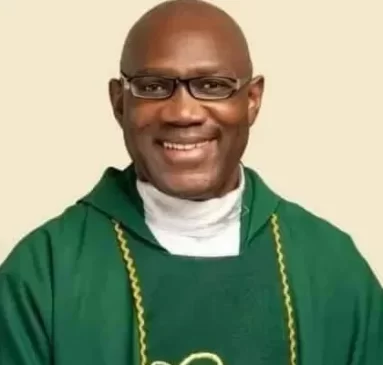
By Fr Michael Nsikak Umoh
1. The Gospel of Matthew (28:8-15), featuring the post-resurrection story, presents us with a trembling contrast. While the women ran with “awe and great joy” to announce the Truth of the risen Lord, a transaction of darkness was hatched underground in the corridors of power. The chief priests and the soldiers were engaged in a conspiracy of lies, deception and silence; all fuelled by bribery.
2. The scenario marked a defining division of humanity, and the continuous quest for answer to the question Pilate asked Jesus: What is Truth? (John 18:38). With Jesus, there will always be proclaimers of the resurrection on the one hand, and the enemies of the cross (Phil. 3:18) on the other. Hence Jesus declared “Do you think that I have come to give peace on earth? No, I tell you, but rather division” (Luke 12:51).
3. The moment of conspiracy by the chief priest and the soldiers is not just a historical footnote, but a blueprint of how corruption systematically enters, captures and dismantles the soul of a nation.
4. Corruption, as seen in the bribe given to the soldiers, is never value-neutral because even when unsuspecting, it comes with damning consequences and casualties. Another error to be avoided is that money is not the only currency of corruption; but also, influence, power, emotion, and even silence.
5. As was evident in the Gospel passage, while money was the currency for the soldiers who were “handed a considerable sum of money”, power was the currency for the governor the soldiers were accountable to. Just in the same manner, money was not the immediate currency for Pilate, but power and social and political relevance: “If you release this man, you are not Caesar’s friend” (John 19:12).
6. In this way, corruption enters into a system, and acting like cancer within, it spreads its poisonous glands through different avenues. Let us consider 3 ways here:
a. The Death of Merit and Truth: When the chief priests who are supposed to be the moral custodians of the society, paid the soldiers to lie, they killed the “Truth.” In a nation like Nigeria, when positions are bought, court judgements upturned by judges, or election results are falsified by the electoral officials, then the righteous, the innocent and most competent voices are silenced and removed from the scheme of leadership. Consequently, the “Resurrection” of progress is suppressed. It is in this way that touts and misfits take over the reign of the nation. Today in Nigeria, there are still outstanding gallant security personnel, but as long as people are paid to grow by compromising their professional responsibilities, mediocrity remains the order of the day. This explains why, for instance, we have more of “political military officers” today, and innumerable judges of questionable character.
b. The Institutionalisation of Falsehood: The Gospel notes that “this story has been spread among the Jews to this day.” Corruption creates a false narrative that are told repeatedly to the point that they begin to appear like truth in the society. This false narrative makes people believe that “nothing works” or that “survival requires dishonesty,” trapping an entire generation in a cycle of cynicism. We partake of the wrought, not only by being physically involved, but also by supporting it with our currency of influence and promoting it through gossip and our social media activities! There are even Catholic families today where false narrative are spread from parents to the children. People buy into it and spread the lies even when they know it is not true. Yet such Catholics live with it and still confidently and habitually partake of Holy Communion. How much lies and falsehood daily destroy our parish communities?
c. Economic Paralysis: The money used to bribe the soldiers was likely taken from the Temple treasury; resources meant for God’s work and the poor. When national wealth is diverted into private pockets, used to set up and boost family business, and used to “cover up” failures, the result is the hardship and poverty we see today in Nigeria. The patrimony of the people is coveted for personal ends instead of the common good. Everyone seems to complain, but very few are ready to confront the evil.
7. When corruption becomes the operating culture of any community, as we now have in Nigeria, the implications are devastating. Among other vices, like the soldiers who abandoned their post for a bribe, institutions meant to protect the people become compromised, and people no longer perform their duties because competence and merits are sacrificed on the altar of nepotism and tribalism. People no longer care about being truthful, accountable and professional. Hence, we have insecurity, deplorable infrastructure, the reign of mediocrity and outright incompetence, and all the terrible things we can imagine in the nation.
The fall out is erosion of trust, as citizens stop believing in the law, leading to the “Galilee of despair” rather than the “Galilee of encounter.” In no time, things gradually fall apart, and the center no longer holds.
8. The Resurrection is the ultimate proof that Truth cannot be buried forever. Peter, in the first reading, was able to stand boldly because the power of the Holy Spirit had liberated him from the fear of the “Chief Priests” of his time. That is the Spirit of the Resurrection which we received at baptism; we renew this awareness at every Easter celebration in a special way beginning with the 40 long Lenten days of preparations. “For God did not give us a spirit of timidity, but a spirit of power and love and self-control” (2 Tim. 1:7).
9. As Christians in Nigeria’s challenging landscape, the Easter mandate calls us to:
a. Be “Authentic Witnesses” like the women who though had no soldiers’ weapons or the priests’ money, but they had the Truth. Today some parents do not even have the least courage at home to guide their children on the path of truth. At the least tantrum from their children, they abdicate their parental role to their Children. Parents have a divine responsibility to guide and form their children; trading it amounts to emotional corruption. Our duty is to live with such integrity that our lives “bribe-proof” our character. Truth is indeed simple and eternal
b. Jesus commanded his disciples to meet Him in Galilee. “Galilee” is the place of our everyday life and work. We must reclaim our “Galilee”. We must take the power of the Resurrection into our families, churches, offices, markets, and political spaces.
c. Whether it is a small bribe to bypass a queue or a large-scale embezzlement, we must struggle to reject the “Hush Money”. Christians must remember that the soldiers’ money brought them no peace, but the women’s message brought them eternal joy.
10. In conclusion, the soldiers took the money and did as they were told, but they remained in the dark. The disciples followed the Risen Lord and changed the world. As we celebrate this Easter Monday, let us recognise that the same Spirit that raised Jesus from the dead lives in us. It is a power that empowers us to say “No” to the darkness of corruption and “Yes” to the light of a new, transparent, and flourishing nation.
May the Risen Christ grant us the boldness of Peter to speak and stand for truth; and grant us the faithfulness of the women to always run toward the light. Amen.