“Pope Benedict XVI lived and was Sustained by His Christian Faith”
1. In the First Reading, the book of Wisdom tells us that the souls of the righteous are in the hands of God. As we mourn the death of our beloved pope, scholar and pastor, this biblical text gives us hope. Like Joseph the earthly Father of Jesus, Pope Benedict XVI was a just man. Since his justice has placed him in God’s hand, we rest assured that he is living in God’s love that gave him strength throughout his 95 years of a life well lived.
2. Joseph Ratzinger/Benedict XVI was born on April 16, 1927, at 8:30 am in a village called Marktl in the region of Bavaria in South-East Germany. Birthed into a deeply Christian family he owes his religious formation and deep personal convictions, he was the third of three children; with an elder brother and a sister. When he was about four years old, he was among the children who welcomed his then archbishop of Munich, Cardinal Michael von Faulhaber with flowers on his pastoral visit to the little Town of Tittmoning in 1931. The young Ratzinger was so impressed by the cardinal’s distinctive garb that he remarked later in the day: “I want to be a Cardinal.” The Lord who uses various ways to call us must have used that occasion to sow the seed of a vocation that will have much impact on the whole world and the Church.
3. After his primary education, at the age of 12, in 1939, he was admitted into the Minor Seminary to be a priest. But his education was interrupted in 1943 when the German leader, Adolf Hitler, started the Second World War. Only after the war was he able to continue his studies. He later went to the major seminary in Munich and in 1951 on June 29, he and his brother George were ordained priests by Cardinal Faulhaber.
4. After his ordination, he was an assistant parish priest for about a year till he was posted to the Seminary in Freising. This was the only official parish experience he had. He completed his doctoral dissertation on St. Augustine in 1953, and four years later, he completed his post-doctoral research or Habilitation on Bonaventure in 1957. The Habilitation was a formal qualification to become a university professor in Germany. He became a professor a year later in 1958 at the age of 31. He taught in many German universities and when the Vatican II Council (1962-1965) began, he participated in the Council as a theological adviser (peritus) to Cardinal Joseph Frings of Cologne. He was known for his progressive views that were innovative in the drafting of many of the documents of the Council.
5. But shortly after the Council, he did not think that the interpretation of the Council by some was going in the right direction. He disagreed with those who saw the Council as a break from the past. For instance, a certain priest who was a professor at a German university, Hubertus Halbas, began to teach that since Vatican II we do not need to preach to people to be converted. All we need to do is to ask the Protestant to be a good protestant, the Muslim to be a good Muslim, and the Buddhist to be a good Buddhist. Ratzinger replied that if he believed such, he will no longer recite the creed. Mission, which is the proclamation of the faith, and conversion are central to the faith. We cannot hold on to the absolute claims of our faith and still refuse to proclaim it. Respect for freedom of religion is not the same as a compromise of faith or indifference. He sought to show that the Council will be best interpreted as a continuity with the past with innovations that led to developments and not rupture or corruption of the faith.
6. He was appointed a bishop on March 24, 1977, and a few months later he was consecrated on May 28, in less than a month on June 27, he was created a Cardinal. Did his childhood desire come true? We might say yes, but it was not the fruit of selfish ambition. He was comfortable in his teaching career which he carried out with humility. It was a tough decision for him to accept the bishopric until he sought the advice of his spiritual director.
7. He had met Pope John Paul II, the then Karol Wojtyla at Vatican II. The pope had also read some of his writings. A year after he was elected pope, in 1980, John Paul II wanted Cardinal Ratzinger to come to work with him in Rome as the perfect for the Congregation for Education. But Ratzinger appealed to the pope that he had just been elected a bishop of his diocese and he would be grateful if he is allowed to spend some more time as a bishop of his diocese. Pope John Paul II obliged him. But one year later, the pope renewed his call for him to come to Rome and this time to work as the prefect of the Congregation of Doctrine (CDF). Ratzinger obliged and a year later in 1982, he resigned as the archbishop of Munich. He remained the prefect of CDF from 1982 until the death of Pope John Paul II in 2005. On three occasions, he had wanted to resign as the prefect of CDF to have more time for study and writing. But each time, Pope John Paul II rejected his resignation. When Pope John Paul II died, he was elected as pope Benedict on April 19, 2005, a few days after his 78th birthday. During the conclave, when he saw the way the voting was going and the likelihood that he might be elected, he said he prayed: “Lord do not do this to me.” But he noted that this time the Lord did not hear his prayers.
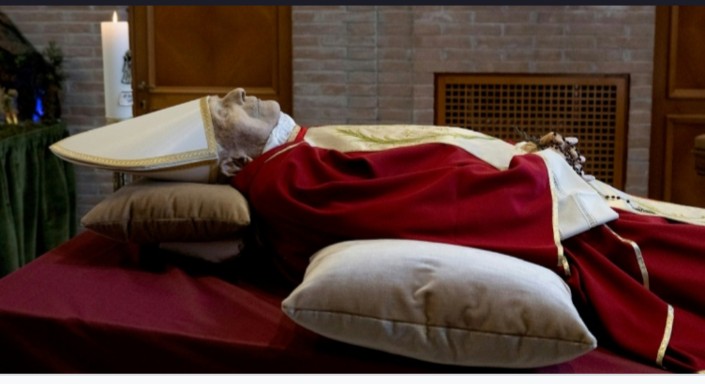
8. He reigned as pope for about eight years. He wrote three encyclicals; Deus caritas est, Spe salvi, and Caritas in veritate, in addition to many apostolic exhortations, homilies and addresses. As pope, he also published three volumes of the Jesus Books, which he wrote as a private theologian. On February 11, 2013, a few months shy of his 86th birthday, he announced that will resign as pope due to old and failing health. The resignation took effect 17 days later on February 28, 2013. He first moved to Castel Gandolfo and later returned to the Monastery in the Vatican where he resided for over nine years of his retirement in silence and prayer for the whole Church until the Lord called him on December 31, 2022, at 9:34 am.
9. Among his many contributions to the Church, his resignation will stand out in helping the Church to attune better to modern realities. Now that people live longer due to modern facilities that can preserve life even in the fragility of old age and debilitating health, it is clear that not every health condition will be suitable for the exercise of the office. In becoming the first pope to resign after 600 years, and the third in the history of the Church (after Gregory XII in 1415 and Celestine V in 1294), he brings the office of the pope nearer to modern sensibilities. The papacy is not a monarchy or a personality cult. It is an invitation to serve God and men. Even though he had a saintly predecessor who lived his last days in suffering and frailty, his deep sense of humility and self-abnegation did not make him capitalise on this to hang on to power. He knew that the office was not about him, but about his service to God and men, and this sense of responsibility made him discern that it was time for him to resign. When people expressed fears about the direction of the Church after he announced his resignation, he assured them that Peter’s boat will never sink. If the Church is not ours, but God, then the good Lord will preserve the Church till the end. He promised to remain with the Church in prayer.
10. Among the last words, he penned was a letter he wrote to his former diocese of Munich last February: “Quite soon, I shall find myself before the final judge of my life. Even though, as I look back on my long life, I can have great reason for fear and trembling, I am nonetheless of good cheer, for I trust firmly that the Lord is not only the just judge, but also the friend and brother who himself has already suffered for my shortcomings, and is thus also my advocate, my “Paraclete.” In light of the hour of judgement, the grace of being a Christian becomes all the more clear to me. It grants me knowledge, and indeed friendship, with the judge of my life, and thus allows me to pass confidently through the dark door of death.”
11. In the letter, he wrote that he was in his final days awaiting the last judgment. He said he knew that he was not only going to meet a just judge, but he was also going to meet a brother and a friend. This brother and friend is the one who has died for his shortcomings and therefore will be his advocate on the day of judgement. He continued that the strength of this pope comes from the baptismal grace he has received as a Christian. He expressed a similar statement upon his election as pope: “Dear brothers and sisters, after the great Pope John Paul II, the Cardinals have elected me, a simple, humble labourer in the vineyard of the Lord. The fact that the Lord knows how to work and to act even with insufficient instruments comforts me, and above all I entrust myself to your prayers. In the joy of the Risen Lord, confident of his unfailing help, let us move forward. The Lord will help us, and Mary, His Most Holy Mother, will be on our side. Thank you.”
12. After identifying himself as a humble worker in the Lord’s vineyard, he said his assurance in accepting the Petrine office was because he is sure that the Lord can and does make use of insufficient instruments. What is most remarkable in these statements is that at the end of the day, the greatest treasure we have in life and the Church is not the position we occupy, but it is the grace of our baptism. Pope Benedict XVI did not call upon the status of his bishopric or papal office to assist him at the point of death, but it is the baptismal grace he called upon. In this way, he echoes the famous saying of his mentor, Augustine: “For you, I am a bishop, with you, after all, I am a Christian. The first is the name of an office undertaken, the second a name of grace; that one means danger, this one salvation” (Sermon 340). On judgment day, it is not our position in the Church that will be our advocate, but it is the grace of our baptism and how we have corresponded to this grace in all we do. The code of Canon Law rightly anticipates this fact when it implies that all are equal in the Church by our baptism (Canon 208). Those who out of sycophancy, manipulative means or rebellion prioritise the ascension of ecclesiastical offices over the grace and gift of their baptismal grace miss the essence of why they are Christians and in the Church.
13. The most remarkable fact about Pope Benedict is that he was a Christian. When he was elected pope, the remark of one of the domestic staff was that “This cardinal was a Christian.” His being a Christian permeated the whole of his personality and thoughts. This is why biased media portrayals miss this correct representation. Yes, he corrects and criticises so many ills of our times. A Christian and a pastor must do so. But he does so as a pastor and not as one who fights flesh and blood (Eph. 6:12). His personality always exuded simplicity and kindness.
14. He lived his Christain faith from the truth, and hence his episcopal motto was “co-workers of the truth.” For him, only the truth can set us free. This love for the truth made him hold firm to the Church’s teachings. He was particularly critical of relativism which holds that there is no absolute truth and that everyone, culture or society can have its truth. He emphasised that the Christian faith is intrinsically rational. Faith and reason reinforce each other. He sees many questionable contemporary practices like abortion, transgender, same-sex marriage, etc., as abandoning human rationality. To condemn these is to defend humanity’s common heritage and values. This has often made him express much enthusiasm and hopes about Africa. This is because the Africa traditional culture that still preserves these values and have hope of being further developed with the joy of life are more promising. He has said a couple of times: “Africa: That is the Future.”
15. For Pope Benedict XVI, the truth is linked to love. His first encyclical as pope was on love. His last words before his death were “Lord, I love you.” He lived in love and he died in love. As we pray for the repose of his soul, we have reason to hope for a new intercessor in heaven.
16. May the soul of Pope Benedict and the souls of all the faithful departed through the mercy of God rest in peace. Amen.
Fr. Idahosa Amadasu.