
THE BODY AND BLOOD OF JESUS CHRIST!
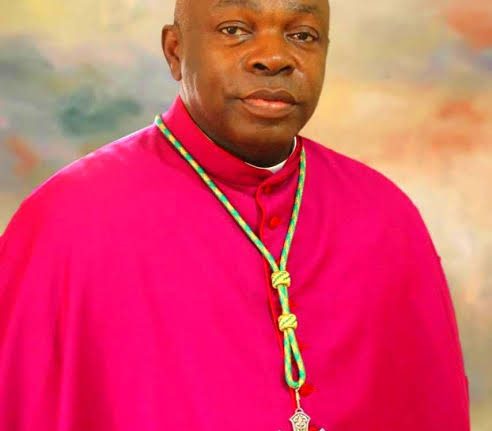
By Most Rev. Matthew Ishaya Audu
(The Archbishop of Jos)
“This is what I received from the Lord, and in turn I passed on to you: that on the same night that he was betrayed, the Lord Jesus took some bread and thanked God for it and broke it, and he said this is my body… .”. In the name of the Father and of the Son and of the Holy Spirit: Amen.
Your Eminences, Your Excellence the Papal Nuncio to Nigeria, Archbishop Anthonio Filipazzi, Your Graces, my Lords, Monsignori, Revd Fathers, Consecrated persons male and female, Dignitaries of the State and of the Church, brothers and sisters.
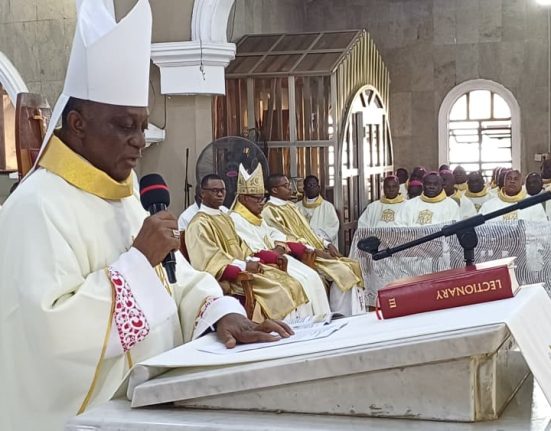
First, my gratitude goes to God who has allowed us to be among the living and to be present at this 5th National Eucharistic Congress holding in the Archdiocese of Benin, Benin City in order to honour the body and the blood of Christ: Corpus Christi. My thanks also go to the planning committee and Revd. Father Banjo for asking me to give this reflection at this Holy Mass with the general theme, “Becoming the Eucharist we celebrate; A Call to Live as One and to serve the Weak”.
We are gathered here today as the people of God in this Nation Nigeria, in the Catholic Archdiocese of Benin, Benin City, to celebrate the special gift that our Lord Jesus Christ gave to the Church in the sacrament of His body and blood. We are here to affirm our belief in the real presence of Jesus in the host and wine consecrated by a validly ordained Catholic priest. We are here to declare our belief in the confirmed and authenticated Eucharistic miracles that have happened in different parts of the world through the centuries. We are here to acknowledge our brokenness, to ask for forgiveness for our failings, to get reconciled with one another and to commit our lives, families, Archdioceses, Dioceses, cities, and our country Nigeria to God’s mercy, care, and providence.
For better understanding, honour, adoration and worship of the Corpus Christi: The body and the blood of Christ that we are honouring today. I will like to begin by saying something about the importance of food and blood to our physical life as living beings.
Food is a vital necessity for all living things like plants, animals and we human beings. In the case of us human beings, food seems to be the most important reason why we do a lot of things. It is the reason why most of us go to school, farm or do other works. For instance, we go to school because we want to get an education so that we can get a job that will fetch us money with which to feed ourselves and our dependants. Food is the reason why most people work. Again, they want to earn money with which to buy food for themselves and their dependants. The reason why food is so important is obvious. Without food we cannot live; without food we will certainly die. I believe it is the same thing with air and water as well.
It is thus obvious that we need food to sustain our physical life in order to stay alive physically. But physical life is not the only kind of life there is. There is also spiritual life, the life of the soul. Obviously we cannot sustain that one with physical food since it is simply not physical itself. There must be some other kind of food that will sustain it. The Spiritual food and that spiritual food is the Corpus Christi: the body and the blood of Christ which we call the Eucharist.
The Eucharist which we have come to honour today, Corpus Christi contains a lot of instructions for our lives, particularly those of us who are Catholics. This body of Christ reminds us, first of all, of the wonderful love and the closeness of Jesus to sinful and weak brothers and sisters like us; and also of his presence in the Blessed Sacrament as the source of every grace that we might need for our spiritual journey. The body and blood of Christ is meant to strengthen us. It is meant to renew the faith of those of us who are weak. And also it is meant to bring new life into the faith of those who are touched by the celebrations.
The food we eat usually gets converted into blood to further nourish the cells in our bodies. Among the ancients blood was believed to be the principle life in a living organism: animal or human. The reason was simple; if you drained the blood completely from an organism, it would die. So, the blood was believed to be the very life of a living organism. It was almost equated with the soul. That, for instance was the reason why the Jews were forbidden to eat any meat with blood in it, as we find in the book of Deuteronomy 12:23, “Take care, however, not to eat (the) blood, since blood is life, and you must not eat the life with the meat.” There was an easy passage to the belief that certain offence could be expiated only with blood. They were what we would call “capital offences” today. Anyone who committed such offences in those days had to be put to death. The way to do that was to inflict a wound that would drain the blood completely out of that person, and then he would die. With the passage of time, the belief was established that the shedding of blood could be done vicariously; that is, the blood of someone or something else could be shed to atone for the guilt of the actual offender. That was something the Jews were commanded to do in numerous texts of the Old Testament. The blood of animals was shed to cleanse human beings of their sinfulness, as testified by the author of the letter to the Hebrews 9:11-15: “The blood of goats and bulls and the ashes of a heifer sprinkled on those who have incurred defilement and restore the holiness of their outward lives.” When, therefore, the Son of God came into this world to cleanse the human race of its sinfulness, it was necessary that blood be shed. The priests of the Old Testament (Old Covenant) shed the blood of animals, not their own blood, to cleanse Israelites of their sinfulness. In the case of Jesus, the High priest of the New Covenant, it was not the blood of animals that he shed, but his very own blood to cleanse the human race of its sinfulness. Again, that is what we are told in the letter to the Hebrews 9: “… and he has entered the sanctuary once and for all, taking with him not the blood of goats and bull calves, but his own blood, having won an eternal redemption for us.” And the Lord Jesus himself said in the Gospel of Mark, “This is my blood, the blood of the covenant, which is to be poured out for many.” Thus, the shedding of Jesus’ blood was a vicarious shedding of our own blood. He shed his blood so that our own blood would not be shed. That is to say, he died so that we would not die. In doing so, he saved us from eternal death as a result of our sinfulness. That was how Jesus won our redemption. We can say that we have been redeemed through the blood of Jesus.
Imagine the high price that was paid for our salvation: the load of Jesus, the very Son of God, not the blood of any animal, as in the Old Testament, not even the blood of a mere human being. That goes to show how much our salvation meant to our heavenly Father. We are accustomed to judge the value of an object by the price that we pay for it. If we pay little for something, we don’t value it much, whereas if we pay a lot for it, we place a high value on it. If the price that was paid for our salvation was the blood of the Son of God, then we must be extremely valuable in the sight of God. Now, that applies to every human being, the little no less than the great. All of us are valuable in the sight of God.
In the gospel reading of today, taken from St. Luke 9:11-17, Jesus miraculously fed over five thousand people; out of share generosity so as to prevent them from feeling any pangs of hunger on their return journey home. This act of Jesus, according to many Christian scholars is a foretelling of the institution of the Holy Eucharist. Jesus arranged this feast of the body and blood of Christ for us his present and also the future followers. This is done through each Mass that we partake. Many of us believe that Christ is present in his divinity and humanity when we receive the Eucharist. We believe that he comes personally to each one of us when we receive him in Holy Communion.
The details of the precise presence have remained controversial even among the different denominations. We Catholics, profess the real and permanent presence. The Presbyterians and Methodist understand his presence in more figurative sense. Some Lutherans follow a middle course and see the presence as real but temporary. Let these different opinions by different Churches not confuse us about Jesus real and permanent presence among us. It does not matter what we Catholics, Methodist or Lutherans believe about the Eucharist. What really matters is what Jesus himself believed about it when he established the Eucharist. In the Gospel of Mark, we read “…this is my body…this is my blood”. This is what Jesus believes about it himself. Christ did not mean the Eucharist to be just a symbol, but real presence. I want to share with you a Story that was told by a Bishop in one of the sermons we heard at the second National Eucharistic Congress celebration that took place at Owerri Archdiocese, Imo state, in 1992.
In one of our African countries, there was this Catholic woman who got married in the Church and for over ten years had no child of her own. As it is in most of African tribes, if you have no child you have not married yet. So this woman got worried. She prayed for a child and it was not coming forth. She decided to visit a native priest of a particular shrine for help. As a mockery he asked her if the Eucharistic Jesus that she adores so much did not help her? She said no. He said okay next Sunday you will still go to the Church and collect the communion but do not eat it; bring it to me here and abuse it before me and I will give you a child which you desire so much.
The following Sunday, the woman was among the congregation in the church for Holy Mass, but not to worship God or receive the Eucharistic Jesus for her spiritual life growth, but to collect for an abuse in the native priest’s shrine. When it was time for communion she was among the first to receive. She then spat the consecrated host into the handkerchief and left the church; went home put it in the basin as it was instructed by the native priest and left to the shrine.
According to the story, a few yards from her house to the shrine, the communion in the basin turned into a baby and started crying. In fright, she put the Baby down in the basin and ran to call people. This news reached the Parish priest, who in turn related the story to the bishop of that diocese immediately.
The bishop then ordered that the Baby should be taken into the church and put in front of the Altar. As soon as they brought this Baby into the Church and placed in front of the Altar, it stops crying. The bishop then, asked the diocese to go on reparation for this sacrilegious act for a week. On the Sunday that followed, the bishop himself presided over the closing Mass and at the consecration the child turned back into the Eucharist. For some of you this may sound like other African tales. But if you believe that nothing is impossible to God, why do you question this?
The Eucharist is the continuation of the incarnation, and therefore the physical presence of Christ among us. Let me read to you what Jesus had told Sister Anna in the apparition on the 14th July 1988 in Rome. “I am very present in every consecrated Host. By replication of my presence in each particle all over the world, I dwell and abide sacramentally. This is the very and the universal presence of my divine love for all of you.”
Jesus established the Eucharist because we need a moving force to enable us to become and remain children of God. Just as we need food to feed our physical body, the Eucharist is instituted in order to feed our souls, to nourish our spiritual bodies with heavenly food, to thrill our souls with the taste of infinite love. And above all, to stay with us after he has returned to the Father.
There is an Indian proverb, which says: “I laugh when I hear that the fish in the water says I am thirsty”. You mean you are a fish? Yes, and you are in the water? Yes, and you are thirsty? Would you believe that that is the image of many of us Catholics? You mean you are a Catholic, celebrating the Eucharist, every day, every Sunday and attending benedictions, do visitation to the Blessed Sacrament and you are looking for Jesus? I can’t believe this. St. Paul in his letter to Corinthians (10:16) says. “The blessing cup that we bless is communion with the blood of Christ and the bread that we break is a communion with the Body of Christ.” Another word for communion is Companion. The word companion comes from two Latin words: cum which means with, and panis which means bread. So we can say a companion literally means someone with whom we share bread. At Holy Mass, we share bread with Jesus. Therefore through every Eucharist that we celebrate, we enter God’s intimacy and begin to share in the divine life. Then we can say confidently with St. Paul “It is no longer I who lives, but Christ lives in me” (Gal 2:20).
The dominant and indispensable characteristic of the Eucharist is the act of eating the victim that is offered: “This is my body take and eat!” Therefore in any celebration of the Eucharist for it to be completed, Jesus body that is offered has to be eaten. Jesus himself says in John 6:52-56 “I tell you most solemnly, if you do not eat the flesh of the Son of man and drink his blood you will not have life in you. Anyone who does eat my flesh and drink my blood has eternal life, and I shall raise him up on the last day. For my flesh is, real food and my blood real drink.”
The Eucharist is true food and drink but at the same time it is very different from every other food and drink that we human beings consume. The great difference between them lies in these words of Christ which St Augustine heard in prayer, “You will not change me into yourself as you would do with food of your flesh, but you will be changed into me.” We transform ordinary food into our own bodies but the food of the Eucharist transforms us into the body of Christ.
One of Gospels tells us that after the resurrection, on the road to Emmaus, the disciples did not recognize Jesus until he took bread, broke it, and handed it to them. And their eyes were opened and they recognize him. This shows the importance of eating the body and drinking the blood of Christ in order to recognize him and know him more intimately.
St. Paul in his instruction on how to receive the Eucharist says: “Everyone is to recollect himself before eating this bread and drinking this cup; because a person who eats and drinks without recognizing the body of Christ is eating and drinking his own condemnation (1 Cor. 11:25-30)”. Yes, my brothers and sisters it is as serious as that! How often many Catholics are seeing, receiving communion without adequate preparation, in the state of sinfulness and without going to Sacramental confession?
Finally, as we mentioned earlier, the Eucharist is true food and drink but at the same time it is very different from every other food and drink that we human beings consume. We transform ordinary food into our own bodies but the food of the Eucharist transforms us into the body of Christ. This is to say we become Jesus in his Love and in his self-giving to others. As Catholics, celebrating the Eucharist, every day, every Sunday and attending benedictions, do visitation to the Blessed Sacrament and going for Eucharistic congresses in our Parishes, dioceses or national one like this one, we should like Jesus become bread broken for others in love and service. This is the way we can become the Eucharist we celebrate; A Call to Live as One and to serve the Weak” as our theme of this National Eucharistic Congress suggests. The priest at the end of each Eucharistic celebration says Ite Missa EST and charges us to go and bear witness to the mysteries we have celebrated by glorifying God with our lives.
We can say in summary form then, that the Eucharist: the body and blood of Christ which we are honouring today in this congress is a feast that shows us very clearly how God cares for us, how God answers our needs and how God provides for us. The Eucharist is Jesus’ last will. Will is a legal document or spoken words on how to deal with one’s remains and properties after one’s death. In the olden days up to the time of Jesus’ earthly life, Wills were not written. People rather say their will usually as their last words before death. Jesus deliberately kept the institution of the Holy Eucharist until his last night on earth, on Holy Thursday. St. Paul recalls the most important part of the spoken will of Jesus before he died: “on the same night that he was betrayed, the Lord Jesus took some bread and thanked God for it and broke it, and he said this is my body that is for you. Do this in remembrance of me. In the same way he took the cup also… and said, ‘This is the new covenant in my blood. Do this, as often as you drink it in remembrance of me’” (1 Cor. 11:23-26). It is Jesus’ will through the Eucharist to feed us with his body as our Spiritual food on our Journey to heaven. It is Jesus’ will through Eucharist to save us by the shedding of his blood. It is Jesus’ will that the Eucharist will be his real physical presence and just not symbolical. It is Jesus’ will that the Eucharist will thrill us with God’s infinite love. It is Jesus’ will that the Eucharist will be his way of remaining with us after he has returned to the Father. It is Jesus’ will that through the Eucharist, we will become like him in love and self-giving to others. It is Jesus’ will that through the Eucharist our lives will become bread broken and libation poured out for the betterment of humanity.
Oh! Sacrament most holy, oh sacrament divine all praise and all thanksgiving be every moment yours. Oh Sacrament most holy, oh sacrament divine all praise and all thanksgiving be every moment yours. Oh! Sacrament most holy, oh sacrament divine all praise and all thanksgiving be every moment yours. Jesus, I love you, all I have is yours, yours I am and yours I want to be, do with me whatever you will. Jesus, I love you, all I have is yours, yours I am and yours I want to be do with me whatever you will. Jesus, I love you, all I have is yours, yours I am and yours I want to be, do with me whatever you will.
+AB Matthew Audu Jos