

Pope invites Canadian clergy to confront challenges of secularized world
By Benedict Mayaki, SJ
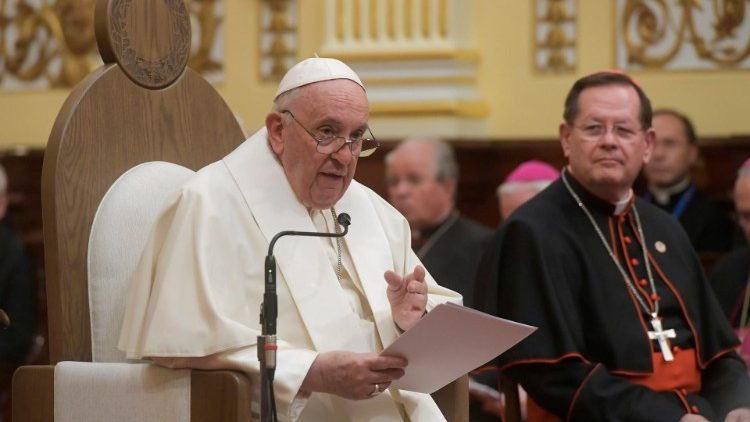
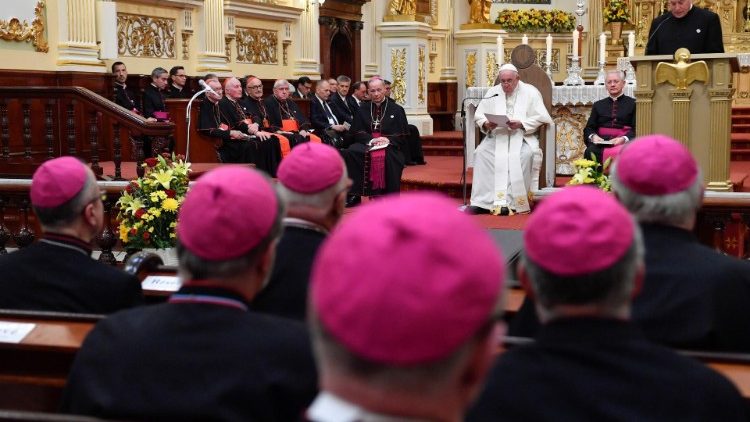
Pope Francis, on Thursday evening – the fifth day of his Apostolic Journey to Canada – presided at Vespers with Bishops, clergy, consecrated persons, seminarians and pastoral workers at the Basilica of Notre-Dame de Québec.
During his homily at the event, the Holy Father highlighted the significance of meeting at the Cathedral of the Church, whose first bishop, St. François de Laval, opened the Seminary in 1663 and devoted his ministry to the formation of priests.
He pointed out that readings at the vespers speak about elders (presbyters), noting that St. Peter urged them to tend the flock of God willingly, and so, the Church’s pastors are invited “to show that same generosity in tending the flock, in order to manifest Jesus’ concern for everyone and his compassion for the wounds of each.”

Pastors, a sign of Christ
Tending the flock, the Pope said, should be done “with devotion and tender love” – as St. Peter urges – guiding it and not allowing it to go astray, because “we are a sign of Christ.” Pastors should do this willingly, not as a duty, like professional religious personnel or sacred functionaries but “zealously and with the heart of a shepherd.”
The Pope pointed out that the pastors too are “tended” with Christ’s merciful love and feel the closeness of God. This, he affirmed, is “the source of the joy of ministry and above all the joy of faith.”
Christian joy
“Christian joy is about the experience of a peace that remains in our hearts, even when we are pelted by trials and afflictions,” the Pope said, “for then we know that we are not alone, but accompanied by a God who is not indifferent to our lot.”

He explained that this is not a “cheap joy” like the world sometimes proposes, or about wealth, comfort and security, rather, “it is a free gift, the certainty of knowing that we are loved, sustained and embraced by Christ in every situation in life.”
Threats to joy of faith
Reflecting on the joy of the Gospel in our communities, the Pope pointed at secularization as one of the factors that “threatens the joy of faith and thus risks diminishing it and compromising our lives as Christians.”
He laments that secularization has greatly affected the lifestyle of contemporary men and women, who relegate God to the background. “God seems to have disappeared from the horizon, and his word no longer seems a compass guiding our lives, our basic decisions, our human and social relationships,” the Pope said.

Considering the ambient culture, Pope Francis cautions against falling “prey to pessimism or resentment, passing immediately to negative judgments or a vain nostalgia.” He, rather elaborates two possible views of the world: the “negative view” and the “discerning view.”
Negative v. discerning views
The first view – the negative – is “often born of a faith that feels under attack and thinks of it as a kind of “armour”, defending us against the world,” the Pope said, adding that this view complains that “the world is evil, sin reigns” and risks clothing itself in a “crusading spirit.”
The Pope warns against this, as it is “not Christian” and “not the way of God.” He notes that God detests worldliness and has a positive view of the world, blesses our life and makes himself incarnate in historical situations to “give growth to the seed of the Kingdom in those places where darkness seems to triumph.”
We are called “to have a view similar to that of God, who discerns what is good and persistently seeks it, sees it and nurtures it. This is no naïve view, but a view that discerns reality,” Pope Francis insists.
Secularization and secularism
To refine our discernment of the secularized world, the Holy Father recommends drawing inspiration from Paul VI who saw secularization as “the effort, in itself just and legitimate and in no way incompatible with faith or religion” to discover the laws governing reality and human life implanted by the Creator. Paul VI also distinguished between secularization and secularism which generates subtle and diverse “new forms of atheism,” including consumer society, pleasure set up as a supreme value, a desire for power and domination, and discrimination of all kinds.
As Church and as shepherds of God’s People and pastoral workers, therefore, the Pope says it is up to us to “make these distinctions” and “make this discernment”, adding that if we yield to the negative view, we risk sending the wrong message – as though the criticism of secularization masks “the nostalgia for a sacralized world, a bygone society in which the Church and her ministers had greater power and social relevance.”
Secularization: a challenge for our pastoral imagination
Secularization, continued the Pope, “demands that we reflect on the changes in society that have influenced the way in which people think about and organize their lives” – not the diminished social relevance of the Church.
Consequently, “secularization represents a challenge for our pastoral imagination,” and “an occasion for restructuring the spiritual life in new forms and for new ways of existing.” Thus, a discerning view “motivates us to develop a new passion for evangelization, to look for new languages and forms of expression, to change certain pastoral priorities and to focus on the essentials.”
Communicating the joy of the faith
Pope Francis goes on to stress the importance of communicating the Gospel and the joy of faith to today’s men and women, insisting that it is a proclamation of “a witness abounding with gratuitous love” that should take shape in “in a personal and ecclesial lifestyle that can rekindle a desire for the Lord, instil hope and radiate trust and credibility.”
Indicating three challenges that can shape prayer and pastoral service, the Pope said that the first is “to make Jesus known,” and return to the initial proclamation, amid the spiritual deserts created by secularism and indifference. He added that we must find new ways to proclaim the Gospel to those who have not yet encountered Christ and this calls “for a pastoral creativity capable of reaching people where they are living, finding opportunities for listening, dialogue and encounter.”

An occasion for conversion
The second challenge -witness- said the Pope, requires us to be credible, as the Gospel is preached effectively “when life itself speaks and reveals the freedom that sets others free, the compassion that asks for nothing in return, the mercy that silently speaks of Christ.”
On this note, the Pope thought of the Church in Canada that has been set on a new path after being hurt by the evil perpetrated by some of its sons and daughters. The Holy Father also spoke of the scandals of sexual abuse of minors and vulnerable people.
To defeat the culture of exclusion, Pope Francis advocates that bishops and priests start from themselves and should not feel themselves superior to our brothers and sisters. Likewise, pastoral workers should “understand service as power.”
Fraternity, the third challenge, means the Church will be “a credible witness to the Gospel the more its members embody communion, creating opportunities and situations that enable all those who approach the faith to encounter a welcoming community one capable of listening, entering into dialogue and promoting quality relationships.”