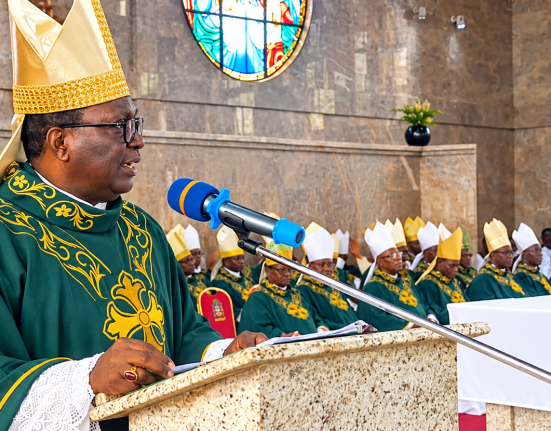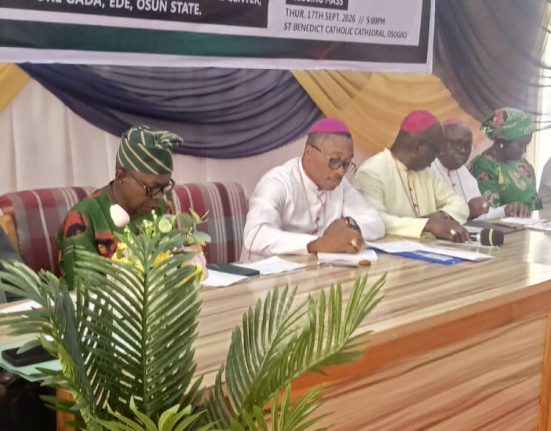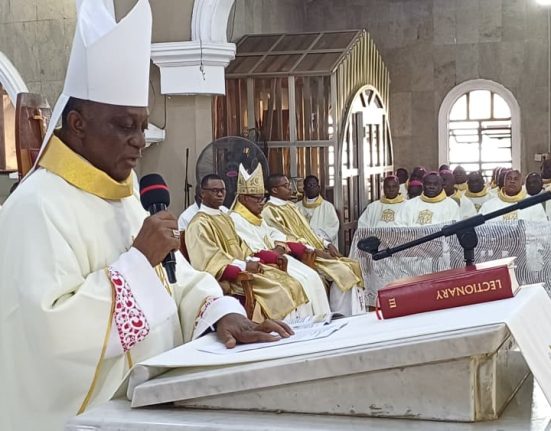

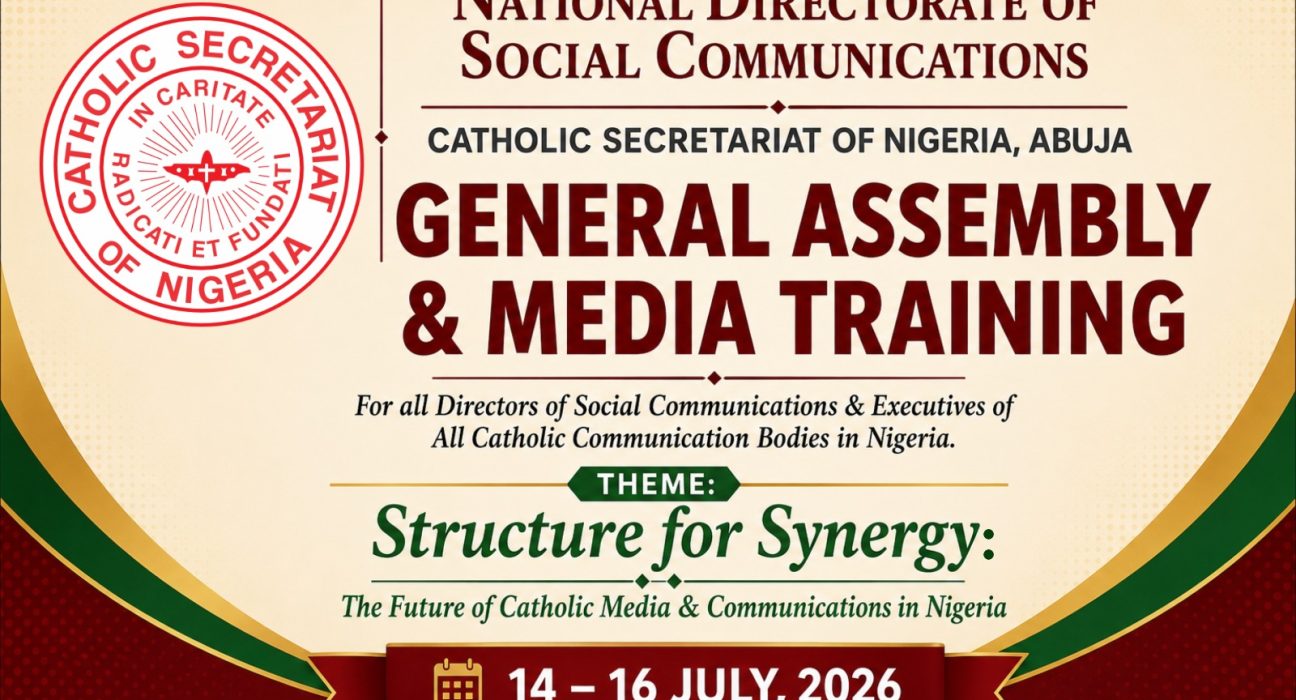
Held at the Catholic Secretariat of Nigeria, Abuja from 14–16 July 2026
Theme: Structure for Synergy: The Future of Catholic Media and Communications in Nigeria
- PREAMBLE
We, the Diocesan and Religious Directors of Social Communications, alongside the National and Provincial Executives of all Catholic communication bodies in Nigeria, gathered for our 2026 General Assembly and Media Training program from 14 to 16 July 2026, at the Catholic Secretariat of Nigeria, Abuja. Guided by the theme, “Structure for Synergy: The Future of Catholic Media and Communications in Nigeria,” we were privileged to have in attendance the Episcopal Chairman for Social Communications, Most Rev. Gerald Mamman Musa, and the National Director of Social Communications, Very Rev. Fr. Dr. Michael Nsikak Umoh. Following constructive and prayerful deliberations on advancing social communications within the Catholic Church in Nigeria, we issue these resolutions as the fruits of our assembly: - THE VALUE OF COMMUNICATION IN EVANGELISATION
We reaffirm the Church’s long-standing teaching that communication is not one other aspect, but it is at the very center of the entire Church’s life and mission. This reality is more relevant than ever in today’s digital age. Recognising that the Church cannot exist without communication, we challenge ourselves and all Catholic communicators to actively work towards ensuring a synergy among all media organs, initiatives, and personnel. In this digital era, which is characterised by media convergence, communicators must strive to become versatile across all media spheres by effectively engaging all available digital tools and the diverse Catholic communication organs across Nigeria. Ultimately, the vision of the Catholic Bishops’ Conference of Nigeria (CBCN) on social communications, especially as articulated in the newly approved CBCN Organogram, guarantees that the path to stronger media evangelisation lies in communion and collaboration, rather than in competition. - UNIFYING ALL COMMUNICATION EFFORTS UNDER THE NATIONAL DIRECTORATE
Following the directives of the Catholic Bishops’ Conference of Nigeria (CBCN), the National Directorate of Social Communications at the Catholic Secretariat of Nigeria holds the primary responsibility of coordinating and guiding all Catholic communication bodies in Nigeria, ensuring that they align with the CBCN’s vision to remain truly mission-oriented. Crucially, the National Directorate serves as the central reference point for the communication efforts of all media bodies, as long as they bear the name “Catholic.” Consequently, all diocesan and religious directors, media bodies, and communication initiatives must work in close synergy and collaborate directly with the National Directorate to achieve a unified voice and purpose. - RELATED RESOLUTIONS
Furthermore, the Assembly also resolved that:
i. The two separate draft Constitutions (one, for the Social Communications Directors and, the other, for SIGNIS Nigeria), which were presented at the plenary of the assembly, are endorsed for use by the respective bodies.
ii. The provision in the two constitutions that the position of the SIGNIS president be occupied by the National Director of Social Communications, who is the official CBCN point person on all communication matters within and outside the country, is upheld.
iii. The office of the Vice President of SIGNIS Nigeria be rotated as provided in the endorsed Constitution of SIGNIS Nigeria.
iv. Like all Catholic sodality groups in Nigeria, all communication bodies must maintain the CBCN statutory structure of Parish, Diocese, Province, and National. Any structure other than these should be dissolved immediately or once the new Constitution of the body takes effect.
v. Training for media practitioners should be organised annually by the National Directorate of Social Communications in conjunction with the body of Directors and other communication bodies.
vi. All Provincial Coordinators of Social Communication should work towards replicating similar General Assembly in their various Provinces.
vii. All communication bodies and practitioners must concentrate more efforts toward promoting media literacy in the Church, especially through active support of the CBCN Communications Week (ComWEEK) initiative.
viii. There is an urgent need to engage Catholic social media influencers to promote the work of evangelisation.
ix. Dioceses and parishes need to be serious about effective management of their websites and social media handles.
x. There is a need to work out strategies for joint production of catechetical materials for the various faith-formation needs of the Church. - THE PROACTIVE ROLE OF CATHOLIC COMMUNICATORS IN NIGERIA’S POLITICAL LANDSCAPE
In light of the upcoming 2027 general elections, the Assembly notes with deep concern that millions of citizens lack the moral and civic formation required to make responsible, value-driven decisions at the ballot box. Therefore, we resolve that all Catholic communication and media practitioners must rise to this challenge by adopting the following strategic roles:
i. Intentionally lead a national project of conscience formation and civic awareness by transforming all Catholic media platforms into avenues of civic education, while reminding the faithful that active, responsible citizenship is a core Christian vocation.
ii. Launch coordinated, grassroots campaigns to encourage all eligible citizens to register, obtain their Permanent Voter’s Cards (PVCs), and actively participate in the electoral process.
iii. Professionally steer the national conversation away from the destructive politics of personality, regionalism, and ethnicity. Rather use all Catholic platforms to elevate the discourse to focus on candidate values, service, integrity, competence, accountability, respect for the sanctity of human life, and a concrete commitment to the common good.
iv. Persistently raise our voices to educate the public against the evils of vote-selling and electoral corruption, presenting these actions as direct violations of moral and Christian values. - CONCLUSION
In commitment to our shared calling, we recognise that the future of Catholic media and communications in Nigeria depends on our willingness to move away from isolated efforts and step into a new era of structural synergy and visible collaboration. By anchoring all our diverse communication bodies under the guidance of the National Directorate, we do not stifle our individuality; rather, we unify our voice and talents to better serve the Church’s central mission of Evangelisation.
As we look toward the critical national milestones ahead, particularly the 2027 general elections, we leave this Assembly with a renewed sense of urgency. We are determined to transform our media organs, both digital and traditional, into instruments of social transformation, conscience formation, and profound civic reawakening.
We seize the opportunity to thank our past Bishop Chairman, Most Rev. David Ajang, while welcoming and congratulating our new Bishop Chairman, Most Rev. Gerald Musa. We pray for the happy repose of the soul of Fr. Anthony Akiwowo and all members who passed away recently.
Entrusting our collective resolutions, initiatives, and professional ministries to the maternal intercession of the Blessed Virgin Mary, Our Lady of Good Counsel and Star of Evangelisation, we depart this assembly resolute in our conviction that if our communication is to be truly credible, our communion and collaboration must remain visible.
Signed,
Very Rev. Fr. Andrew Dewan
(For Body of Comm. Directors )
Amb. Edith Isidahomen
(For CAEAN)
Mr. Adams Suleiman ( For CAMPAN )