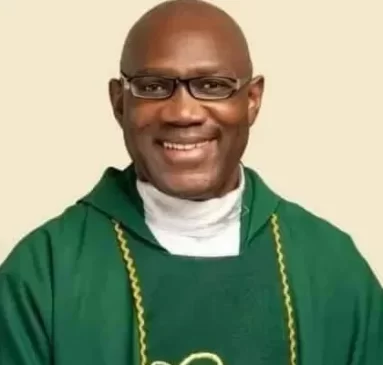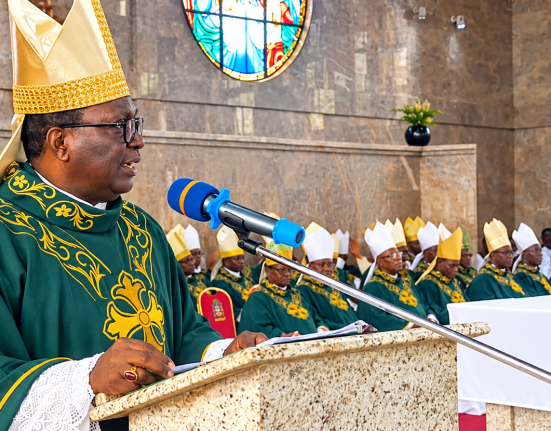


+AB AUDU’S HOMILY On 26th Sunday of Year C
“Now the poor man died and was carried away by the angels to the boson of Abraham… The rich also died… in his torment in Hades he looked up and saw Lazarus in Abraham’s boson.” In the name of the Father and of the Son and of the Holy Spirit: Amen. Good morning my brothers and sisters in Christ! Today, as most of us have known by now already, is 26th Sunday of the Year C.
I will like to begin today’s reflection this way! Imagine you are one among many people who are witnessing how God is judging people and you saw this scene. A man dies and arrives before the Judgment Seat of God. The divine Judge goes through the Book of Life and does not find the man’s name. So He announces to the man that his place is in hell. The man protests, “But what did I do? I did nothing!” “Precisely,” replies God, “that is why you are going to hell for doing nothing.”
That man could as well be the rich man in today’s parable. The Parable of the Rich Man and Lazarus has left Bible readers wondering why the rich man had to go to hell. We are not told he acquired his wealth by foul means. We are not told he was responsible for the poverty and misery of Lazarus. In fact we are not even told that Lazarus begged from him and he refused to help. We are not told he committed any crime or evil deed. All we are told is that he was feeding and clothing well as any other successful human being has a right to do. Why then did he go to hell?
The problem we have, is pinpointing to the reason why the rich man went to hell has a lot to do with what we think sin is. We often think that we sin only by thought, word and deed. We forget a fourth and very important way through which we sin, namely, by omission. In the “I Confess” we say these words: “I have sinned through my own fault, in my thoughts and in my words, in what I have done and in what I have failed to do.” Yet how quickly we forget the sin of omission? Today’s parable reminds us that the sin of omission can land someone in hell. This is what happens to the rich man.
The poor man Lazarus was lying at his gate. And the rich man simply couldn’t care less. “Whatever happens to him there outside the gate is none of my business,” he probably said to himself. “I mind my business. People should mind theirs.” Next, the rich man probably phoned the police to report that a stranger was loitering outside his gate. In the meantime dogs went and licked Lazarus’ wounds. And the poor man died. And the City came and picked his body and buried it in an unmarked grave. And the rich man went in and had another cup of coffee. Of course he did nothing against Lazarus. But he has failed to do a good deed. He failed to reach out and share a little of his blessings with someone in need. His sin is that of omission, and for that he was going to roast in hell.
Another problem we have with this parable is why Lazarus went to heaven. After all we are not told that he was a man of God or that he did a single good deed. Yes we are. In biblical stories of this nature, names are very significant because they often convey the person’s basic character or personality. In fact this is the only parable of Jesus where the character in the story has a name. So the name must be significant for interpreting the parable.
The name “Lazarus” is the Hellenized form of the Hebrew name “Eleazar” which means “God is my help.” Lazarus, therefore, is not just a poor man, but a poor man who believes and trusts in God. This must be why he found himself in Abraham’s bosom in Paradise — because of his faith and trust in God, not just because he was poor. Failing to grasp the significance of Lazarus’ name in the interpretation of the parable, some people have suggested that in the next life there will be an automatic reversal of status: the rich will become poor and the poor will become rich. But this is not the point of this parable. Rich people who use their wealth to serve God in their fellow human beings will still be blessed in the next life. Poor people who spend their lives in bitterness and envy, refusing to believe and trust in God as Lazarus did, may yet again suffer in the next life.
The good news of this parable is this: If you feel like a Lazarus right now, battered by sickness, poverty and pain, forgotten by society and by those whom God has blessed in this life, continue believing and trusting in God knowing that it will be well with your soul in the end. If you see yourself as one of those blessed by God with the good things of life, open your door and observe. Probably there is a Lazarus lying at your gates and you have not taken notice.
There are some Christians who live from day to day very much like that rich man. If you try to tell them that they are not living truly as followers of Christ, they are surprised, and say: “I do not steal. I do not kill. I do not abuse or beat anybody. What is wrong with that kind of life?” To that kind of question, Jesus would probably answer with these questions of His: Do you care for others around you? Do you see the needs of the poor? Do you share what you have with those who have much less? Do you do anything to make their life less painful?
Last week, Jesus told us: “Use money to win you friends… Make sure that when it fails you, they will welcome you into the tents of eternity. This is what the rich man, did not do and therefore he is now very sorry man in hell. If you die today, would you also be sorry? … You may see that you do not give very often to the poor. What you give during the collection here is also very little. Perhaps you think of all that you want to get and when finished buying everything you want, there is nothing left for others…
You have heard this gospel many times before. Many times too you heard someone preaching about it. Has it changed anything in your way of giving to those in need? There are people who “get used to” hearing such a message.” entering through one ear and going out through the other. They do not receive the message. And the story of Jesus tells us: “They will not be convinced even if someone should rise from the dead…
I will end this homily today, with the words of a man who died many years ago. He is called Martin Luther King Junior. He was a Black American. He fought the prejudice of the white people towards his people. This is what he said: “If anyone of you is around when I have to meet my death, I do not want a long funeral. And if you get somebody to deliver the eulogy [the sermon] tell him not to talk too long. Tell him not to mention that I have a Nobel Peace Prize – that isn’t important. Tell him not to mention that I have 300 or 400 other awards — that’s not important. I would like somebody to mention that day that Martin Luther King Junior try to in his life serving others. I would like somebody to say that day that Martin Luther King Junior tried to love somebody. I want you to be able to say that day that I did try to feed the hungry. I want you to be able to say that day that I did try in my life to clothe the naked. I want you to say on that day that I did try in my life to visit those who were in prison. All the other shallow things will not matter. I won’t have any money to leave behind. I won’t have the fine and luxurious things of life to leave behind. But I just want to leave a committed life behind”. And what would you like people to say when you shall meet your death?
Have a magnificent Sunday and a sanctified week!
+Ab Matthew Audu – Jos