
“One thing is needful. Mary has chosen the good portion,
which shall not be taken away from her” (Luke 10:42)
Dear Brother Priests, Consecrated Persons and Lay Faithful of the Archdiocese of Benin City,
May the grace and peace of God our Father, and the Lord Jesus Christ be with you!
I have the privilege once again to address a few words to you at the start of yet another season of Lent. The Church offers us this opportunity for personal and communal repentance and renewal in preparation for the celebration of the paschal mystery of Jesus Christ, which finds it culmination at Easter. During Lent, the Church calls all her children to remember their baptismal call to holiness and to return to the heart of the Father through acts of prayer, fasting and abstinence. Lent beckons us to a retreat of some sort, away from the hustle and bustle of daily life, to reflect on the most essential purpose for our lives, which is friendship with God. We were created to share in the life of God.
Throughout the year we go through life, working hard to make a living and to find meaning. But we could get lost in our pursuits that we might not give due attention to the very principle that animates our bodies to engage in these pursuits in the first place – our soul. Lent is a time to ask if we are engaging in life’s pursuits for the right reason, and if our pursuits are truly and properly oriented. Lent thus calls us to ask some fundamental questions, such as, “Why do I exist?” “Why am I here?” “Do I exist simply to pursue wealth, pleasure or fame and then return to dust?” “Does my life have a purpose, or am I in this world to wander aimlessly?” “What value is there in the human experience of life, suffering and death?”
The month of February is reputable for the celebration of love and relationships. These celebrations remind us of a truth, that we are created to receive and to give love. We are created for relationships. A solitary human being or one who is incapable of loving is an abnormal. God is a community of three divine persons. And as God is, so has he created. But while we have been created for relationships, there is one relationship that is foundational to all others, and is the ground for all others. It is our relationship with God. It is at the heart of every other relationships. The presence of this relationship gives meaning and beauty to all human relationships. When we have a robust and unpretentious relationship with God, we can then mirror that in our dealings with other human beings. One must first feel the love of God in one’s heart to be able to communicate it to others. To be in relationship with God is to recognize our creaturely status and our dependence on God. It is to acknowledge that just as God is our source, he is also our destination. As St. Thomas Aquinas writes in his Summa, we come from God (exitus) and we return to God (reditus). This has a special relation to the inner life of the Trinity and the processions of the divine persons. In the intervening time between our coming out from and returning to God, we must live rooted in friendship with God, and allow this relationship inform and shape our lives. This is the one thing that is needful, which Mary has chosen, and which will never be taken from her (Luke 10:42).
As Archbishop, I am very much aware of the suffering of our people – in our Archdiocese, our country and in the world. I am pained by the failure of the government of the day, and past governments to provide the basic necessities to make life meaningful and enjoyable. Like every Nigerian, I too want a better country. In fact, I want everything on this earth to be perfect for us to enjoy. But I am also aware that no human government, no matter how popular and widely acclaimed, can guarantee the fulfillment of all human desires. I am mindful that God created us for the next; that this earth, with all its glory, is only intended to be ours temporarily. Lent reminds us that we are pilgrims, and there is no wisdom in building permanent castles on this earth, “where moth and rust destroy and where thieves break in and steal” (Matthew 6:19). God wants to get us to heaven, where true perfection lies. The one task we have been entrusted with while on earth is to busy ourselves preparing to go to our heavenly home, which Christ has gone to prepare for all who believe in him (John 14:13).
I do not intend to paint a pejorative picture of this earth, as it is the best one that God could create. Neither do I suggest an “I-don’t-care” attitude to life on earth. On the contrary, my purpose is to shed some light on the true purpose of our life here on earth, as preparatory for that ultimate union with God, which would come to its realization when we behold God face to face. This earth is not the destination; heaven is. And this thought must never be lost on us. I therefore call on us this Lent to take a sincere and intentional look at our lives to see what our motivations are. We must be honest with ourselves and ask some tough questions: What is it that drives our lives? What is at the heart of my choices? What is that which grounds my life and gives meaning to my pursuits? Do I live only for the moment or do I look to the ultimate purpose of my creation?
The Catechism of the Catholic Church tells us that man is the only creature on earth that God willed for its own sake. He alone is called, by knowledge and love, to share in God’s own life (356). This communion with God is the whole purpose for man’s creation. We come from God and are oriented toward union with God in the end. All other creatures are created for something more perfect than itself. But there is nothing in this world more perfect than man. Therefore, man must be created for something outside of this world. And this something is God. Thus, man is created for God alone. It is because of this that man does not find fulfillment in things, no matter how many. We do not find fulfillment in wealth, pleasure or power. The richest among us still wants more, the most beautiful still crave for something more, the most successful and most accomplished are still not satisfied. Nothing in this world fills that void, which led St. Augustine to the conclusion, “You have made us for yourself, O Lord, and our heart is restless until it rests in you” (Augustine of Hippo, Confessions, 1,1.5).
Although God commanded man at creation to be fruitful and fill the earth, this was not the telos for his creation. Man was not created for the sole purpose of populating the earth and stewarding creation. Implicit in this command was the ordering of all of creation to God who made them. So, responsible stewardship is not a goal in itself, to the point that creation becomes a god of its own and deserving of a cult of worship. God is still the center of all of creation, and all human action is to be oriented toward this center.
Lent reminds us of our continued need for repentance. We must repent from the sin of turning away from relationship with God and putting ourselves and created things at the center of our lives. Our first parents, Adam and Eve were constituted in a state of original holiness and justice. They were to share in the divine life. They were to have mastery over themselves and the whole of creation. But through their disobedience, they sinned against God and turned away from friendship with him. They substituted created things for God. They separated themselves from grace, which is union with God. They then bequeathed to the whole of humanity a nature that is at the mercy of the triple concupiscence that subjugate human beings to what the Catechism describes as “pleasure of the senses, covetousness for earthly goods, and self-assertion, contrary to the dictates of reason” (CCC377). These are at the heart of every sin.
We must therefore be intentional during this season of Lent to rid ourselves of actual sins, and the attachment to sin. Through our Lenten observances we train our wills to conform to the divine law and the dictates of reason. Since the goal of the Christian life is perfect union with God, let us seek, during this Lent, to develop and nurture that fundamental relationship that should shape and transform all others. Let us reflect on the suggestion of the Angelic Doctor by starting with lust and pride. St. Thomas Aquinas writes, “there are two sides to every sin: the turning of the will toward fleeting satisfaction and the turning away from everlasting value. As regards to the first, the principle of all sins can be called lust – lust in its most general sense, namely, the unbridled desire for one’s own pleasure. As regards to the second, the principle is pride – pride in its general sense, the lack of submission to God (Paul Thigpen, A Dictionary of Quotes from the Saints, p. 213).
To conclude, I recommend a daily examination of conscience to help shed light on the dark parts of our lives that are under the tyranny of the seven deadly sins (pride, lust, greed, envy, sloth, gluttony, anger) those part parts of our lives that we have not given over totally to the reign of Christ. Once we come to this awareness, we must practice frequent confession. Let us not allow sin to stay on our souls for long. It is in this way that we would privilege our relationship with God, which is the one thing that is needful.
Lenten Regulations 2023
Catholic Archdiocese of Benin City
The following guidelines would help facilitate the faithful observance of the holy season of Lent in our Archdiocese:
The Season of Lent is essentially penitential in nature. Liturgical celebrations must be conducted in such a fashion as to make the people appreciate the spirit of the season. Moderation should be exercised in preparation of churches for liturgical celebrations. Ostentatious decoration of the altar with flowers and ornaments must be avoided. The colour for the season is purple or violet. Alleluia and the Gloria are forbidden during Lent. Also, the playing of musical instruments must be done with moderation, and with care to respect the nature of the season.
Fasting, which is one of the most ancient practices of Lent, is not only about abstaining from food or drink; it also has some spiritual dimensions. It includes turning away from self, a turning towards God and a turning towards others in love. All Catholics are expected to fast and abstain from meat and food prepared with meat, especially on Ash Wednesday (February 22, 2023) and Good Friday (April 7, 2023). Abstinence from meat is also recommended on all Fridays throughout the year. The regulations governing abstinence from meat apply to all Catholics age fourteen (14) and older (Can. 1252). Adults who have completed their (18) year until the beginning of their sixtieth (60) year are bound by the regulations that govern fasting. Pregnant women, sick people and those who care for them are excused from the regulations.
Going to sacramental confession and doing appropriate penances, both those imposed at confession and other voluntary acts of penance. The Code of Canon law (508 § 1) reserves the right to absolve reserved sins as well as latae sententiae censures which have not been declared and are not reserved to the Holy See to the competent ecclesiastical authority and to the canon penitentiary. In our Archdiocese, the competent ecclesiastical authority is the Archbishop, who is the Local Ordinary. He alone can absolve a penitent from guilt of such sins and from the censure of excommunication attached to abortion in sacramental confession. Priests are reminded that the Holy Father has given to all priests the faculty to absolve from the censure of abortion in Sacramental Confession. However, the provisions of the Code of Canon Law on the Sacrament of Reconciliation should be adhered to (cf. Misericordia et Misera, 12)
Other Penitential acts and acts of sacrifice and self – denial, such as keeping away from sin, sinful environments and habits, the intensification of the fight against bribery and corruption are strongly recommended.
Cutting down on ostentatious and lavish celebrations. Avoid unnecessary spending and even denying yourself legitimate things and saving money for works of charity, especially contributing to the Lenten Fund. A person can give up drinking even soft drinks or watching favourite television programmes during the period of Lent. Those who are wedding during Lent are reminded of the penitential character of the season and are therefore urged to exercise moderation in their civic reception.
Lenten Season is a time for solidarity with others in need. Our penance should flow into solidarity with others and generosity in everything especially in giving to the needy and contributing to the works of the Church. Charity, almsgiving, and remission of debts should be practiced; and voluntary donations should be freely made for the various projects of the Church.
Attention to social justice, payment of just wages and prompt payment of debts. Avoidance of litigation and readiness to dialogue and reconciliation. Make peace in your family and community. Attention to the environment, engaging in communal work to keep the environment clean and healthy.
Promotion of the Church’s campaign in favour of life, especially right to life of the foetus, the sick and elderly.
Work for the conversion of sinners and amendment of life of those living in sinful situations.
Lenten period is a time for increased prayer, therefore, all the members of Christ’s faithful are to intensify their prayer life. This includes:
Fidelity to morning and night prayer as they wake up and as they end their day.
Daily Mass.
Frequent confessions.
Frequent and worthy reception of Holy Communion.
Daily family and individual Rosary.
Regular meditative reading of the Holy Bible.
Fidelity to the Liturgy of the Hours, especially for bishops, priests, deacons and religious.
Observing the period of Easter Duty, by going to Confession and receiving Holy Communion at least once a year from Easter Sunday (April 9, 2023) to Pentecost Sunday (May 28, 2023).
Visit the Blessed Sacrament and spend time with our Eucharistic Lord daily.
Take active part in the celebration of the Stations of the Cross in every Church on Wednesdays and Fridays of Lent. Note that a collection is to be made after the Stations of the Cross for the poor and for other social and charitable works of the Church. The collection is to be made after the 14th Station before the prayer before the altar and conclusion. On Good Friday, special collection is taken up for the maintenance of the Holy Places in Jerusalem.
Priests who celebrate the RCIA can administer the complete sacraments of Christian Initiation at Easter. Those of us who are baptized should intensify prayers for the catechumens who will be received into the family of God by baptism during Easter.
Cathedraticum will be had in each deanery on particular dates. Cathedraticum is the occasion of showing a Catholic’s love for and loyalty to the Archbishop of the Archdiocese as the Father and Elder. It is a sort of tribute. All Catholic groups, including priests, every parish, station, every Catholic family, every statutory organization, every association in the Church, and every religious community are expected to give the Archbishop a present in cash and/or kind to demonstrate their filial love for him and to contribute to his work as Shepherd of your souls. All is expected to be generous. The dates are as follows:
Monday, March 27, 2023 Iguobazuwa Deanery at St. Andrew’s
Parish, Iguobazuwa at 10am.
Tuesday, March 28, 2023 Abudu Deanery at St. Thomas Aquinas Parish,
Abudu at 10am.
Thursday, March 30, 2023 Benin City Deanery at Holy Cross Cathedral, Benin City at 10am
For this year, the celebration of Chrism Mass will be on Thursday, April 6, 2023 at the Holy Cross Cathedral, Benin City for the whole archdiocese. There will be No Cathedriaticum on that day. All priests with diocesan assignment and those living in the Archdiocese are to come for Chrism Mass in order to express the unity of the presbyterium and to renew their Priestly commitment.
May the Virgin Mary, mother of sorrows, accompany us in our Lenten journey and support us with her prayers as we strive to draw closer to our Lord in his temptation and in his fast. I hereby call on all to make the most of this Holy Season and to acquire all the graces they can before the season comes to an end.
Given in Benin City this 22nd day of February 2023 (Ash Wednesday).
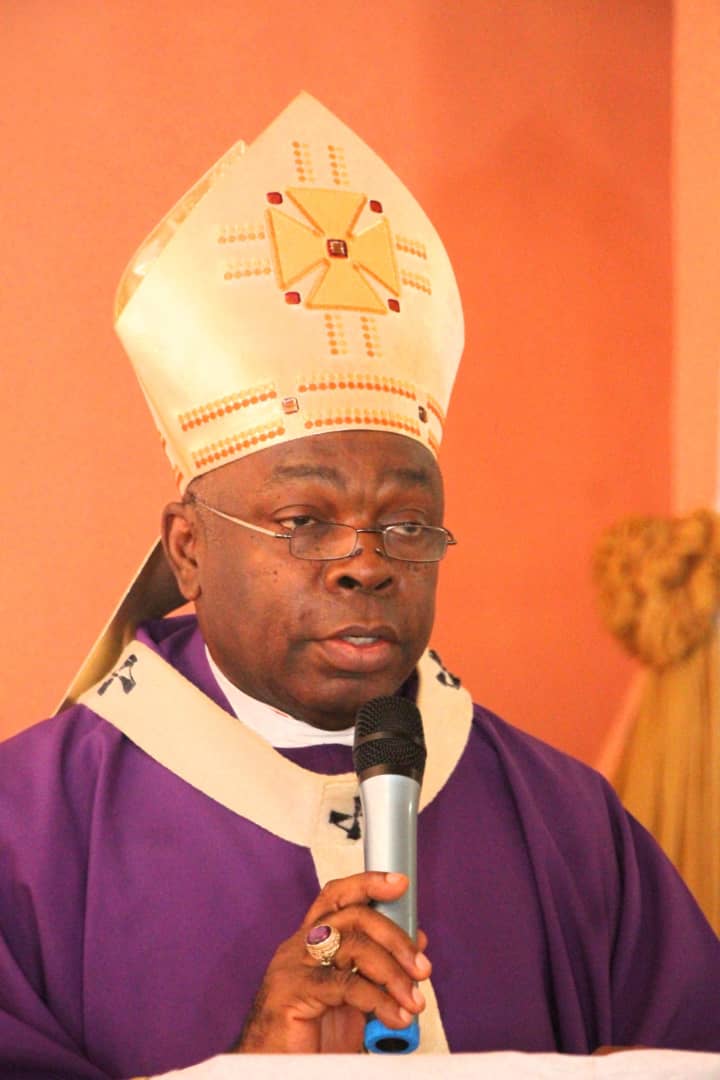
+Augustine O. AKUBEZE
Archbishop of Benin City